• Some users have recently had their accounts hijacked. It seems that the now defunct EVGA forums might have compromised your password there and seems many are using the same PW here. We would suggest you UPDATE YOUR PASSWORD and TURN ON 2FA for your account here to further secure it. None of the compromised accounts had 2FA turned on.
    Once you have enabled 2FA, your account will be updated soon to show a badge, letting other members know that you use 2FA to protect your account. This should be beneficial for everyone that uses FSFT.

AMD Ryzen Oxide Game Engine Optimized Code Tested @ [H]

Kinda reminde me of the old Intel COmpiler issues where it would only run x87 code if it was an AMD cpu btut happiyl do sse if it was an intel even thoug the AMD CPU was fully capable of running SSE.
Had to patched the software back to bypaas this check to get full speed out of the software on an AMD machine.

Does AMD even have a compiler. i think it hurts them a lot not providing one.
 
We have components working as intended, and they have been doing so for quite some time now. Along comes a new component and all of a sudden people start blaming was has been working fine until now.

So let me ask you this; why is anyone questioning the components that have been working fine until the release of Ryzen? Why is anyone blindly glaring passed the single constant at the center of all the issues so far?

how is looking past a potential flaw in your brand of choice any better?

Nobody here is interested in fanboy agenda, we are here because we are curious as to how far along Ryzen has improved from March 2 to current. It is just convenient that the only game that shows anamolous results has to some extent been shown as to why.
 
Did you already forget all the regressions with nVidia in Dx12 titles? I did not. In fact, i even remember them as CPU regressions, and you can even find them in computerbase.de review still.

For all we care, nV driver may suffer from similar issue that appeared in Ashes of the singularity, since the latter was a product of compiler optimization.

No, I haven't forgeten that NVIDIA is weaker at Asynchronous Compute vs ATI cards; which is why higher gains are observed in DX12 on ATI vs NVIDIA. Did everyone else forget?

So now we have people noticing the same trend as a year or two ago; that ATI cards have noticeable gains when switching from DX11 to DX12 due to being stronger at Asynchronus Compute, and all of a sudden it turns into NVIDIA cards hampering Ryzen gaming performance?

You know, the poster ealier might have a point. It is starting to feel as if people are just throwing feces at a wall to see what sticks.
 
Last edited:
how is looking past a potential flaw in your brand of choice any better?

Nobody here is interested in fanboy agenda, we are here because we are curious as to how far along Ryzen has improved from March 2 to current. It is just convenient that the only game that shows anamolous results has to some extent been shown as to why.


Ryzen performance hasn't changed since March 2nd. The chip hasn't changed so why would performance change? If you mean stability, sure; even I can agree with that.

It isn't the only game showing this behaviour. We've seen this eact same behaviour when comparing NVIDIA cards to ATI cards in DX11 and DX12 for over a year now? So congratulations on rediscovering what we already knew?
 
No, I haven't forgeten that NVIDIA is weaker at Asynchronous Compute vs ATI cards; which is why higher gains are observed in DX12 on ATI vs NVIDIA. Did everyone else forget?
Async compute has literally nothing to do with situation at hand, you are missing the point. It is about CPU regression, something you can only blame driver for.
 
Async compute has literally nothing to do with situation at hand, you are missing the point. It is about CPU regression, something you can only blame driver for.

We've known for over a year that nV GPUs are weaker in DX12 vs DX11 and that theinverse is true of ATI GPUs being stronger at DX12 vs DX11; we've known that it's because of Async Compute.

Now, all of a sudden; March 2017, we throw this out the window. It's no longer a fact. That's what you're saying?
 
We've known for over a year that nV GPUs are weaker in DX12 vs DX11
We? I have known for a year it is factually wrong, and whoever pays more gets better performance in Dx12. I also knew that Async Compute has nothing to do with it either.

What is really curious is that Ryzen+nV is hit by CPU regression harder than other combos from what it seems.
 
Ryzen performance hasn't changed since March 2nd. The chip hasn't changed so why would performance change? If you mean stability, sure; even I can agree with that.

It isn't the only game showing this behaviour. We've seen this eact same behaviour when comparing NVIDIA cards to ATI cards in DX11 and DX12 for over a year now? So congratulations on rediscovering what we already knew?

actually performance has changed as everything from Bios (April BIOS updates due soon up on AMD's live PR to have massive gains on memory performance), games constantly changing as the Ryzen ecosystem becomes more public access.
 
actually performance has changed as everything from Bios (April BIOS updates due soon up on AMD's live PR to have massive gains on memory performance), games constantly changing as the Ryzen ecosystem becomes more public access.

Has performance really changed that much so far? Memory is getting higher speeds but the jury still seems out on impact to real world performance. Techpowerup did a look at it.

On the game front, we have Dota 2, and AoTS getting updates, but AoTS is basically AA (and dead, shame). Dota 2 is a good mark, but not surprising. Although we'll see a review of Ryzen with the launch of the 5 series, I'm under the impression most games have the CPUs not really too far behind, most of the time still having pretty high performance, and because of that I doubt that games already released will receive patches for Ryzen. Its upcoming releases that will determine how Ryzen will compete but I'm confident on that front.

Edit: stuff
Edit2: i cant get this sentence to work
 
We've known for over a year that nV GPUs are weaker in DX12 vs DX11 and that theinverse is true of ATI GPUs being stronger at DX12 vs DX11; we've known that it's because of Async Compute.

Now, all of a sudden; March 2017, we throw this out the window. It's no longer a fact. That's what you're saying?

I'm guessing you haven't actually watched the videos showing the issue with using a Nvidia gpu vs an AMD gpu with Ryzen.

We knew Nvidia DX12 is weaker than it's DX11 driver but what we didn't know up until yesterday is that the DX12 driver is actually regressing the true performance of Ryzen.
It points to some issue with the Nvidia driver if simply changing to a 480 mGPU setup has closed the gap between an 1800X and 7700K from 35% to less than 6% in RoTTR. Ryzen's sub-par performance in gaming appears to implicate the gpu variable since nearly every reviewer used a Nvidia gpu for their tests.

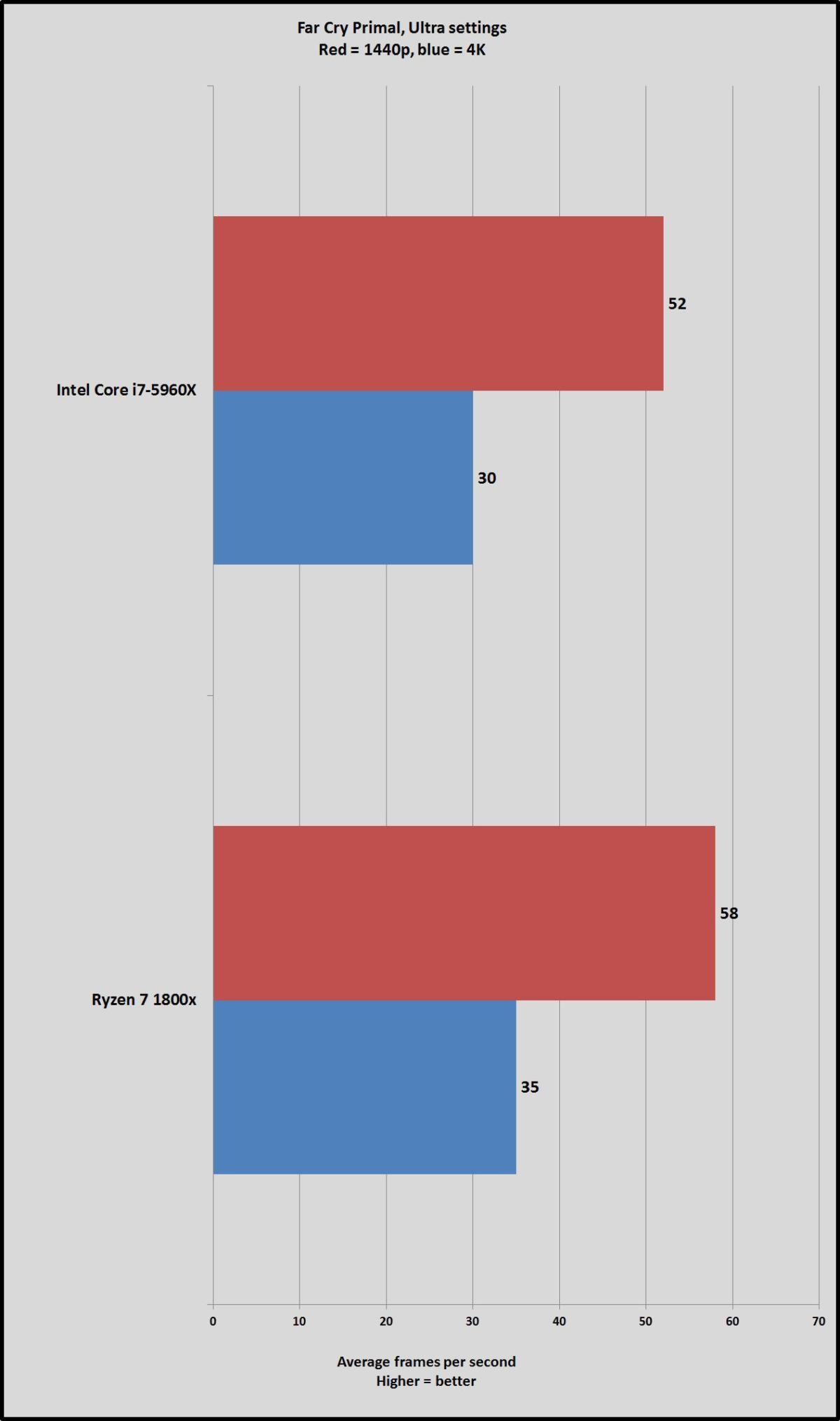
Another bit of evidence that has come up is this PCworld Ryzen review from 2nd March that used a FuryX as the gpu:

http://www.pcworld.com/article/3175...-fire-breathing-apex-of-amd-power.html?page=3

ryzen-build-fcp-100711205-large.jpg


Here we see the 1800X beat the 5960X in Farcry Primal which is contrary to every other review which shows either Ryzen losing badly or just barely matching Intel in this game. FC Primal is not even DX12 so the outlier seems to be the gpu vendor being used. This is something that needs much more investigation since it cannot be coincidentel that those who used an AMD gpu have shown Ryzen to keep up with Intel rather than lose badly in some games.
 
http://www.pcworld.com/article/3176...-or-why-you-should-never-preorder.html?page=2

You are testing GPU bottlenecked scenario and land that 2 CPUs perform similarly.

Swap for 1080p and even with rx480 difference is staggering.

The i5 3570K has a base frequency of 3.4GHz and the ryzen 1700 has 3GHz which accounts for alot.
The test you link shows the i5 3570K + 480 is getting more fps than than a i7 5960K + FuryX in FC Primal @ 1440P when comparing to the chart I posted above. Something not quite right there.

ryzen-7-1700-fcp-100711428-large.jpg
 
The Ryzen 5 1500X has the full L3, as the 1600 and 1600X. 8MB each CCX. Only the Ryzen 1400 which Anandtech confirmed, has half L3, or 4MB each CCX.

Oh, pcgameshardware.de updated the benchmark again, they found the problem. Their savegame, made with a 5820K, has extra dynamic lights on CPUs with 6 physical cores or above, but on 4 cores, it's disabled. This gave the 7700K a huge boost in performance.

When they simulated Ryzen 4 core, it was right on the heels of the 7700K.
Not disagreeing but has AMD confirmed this for the 4C/8t?
Some articles state it is 8MB L3 cache for 1500X.
Some adverts taken down that had it as 16MB had the L2 cache wrong (it must be half the 1800X if going with sum total of all cores), they used the 8C data.
Thanks
 
It is not one small area of the map. Please man, just watch the video towards the end. There are many levels where Ryzen 7 is now nipping the heels of the 7700K on AMD GPUs. But on GTX, its 20-35% behind.

NV's DX12 driver is broken for thread scaling in Rise of the Tomb Raider.

It's actually a shocker considering a lot of review sites tested DX12 games and only used NV GPUs (understandably, due to them being faster), actually resulted in a much worse performance for Ryzen 7 simply becaue of NV's driver bottlenecks for that API, not actually a CPU bottleneck at all. Amazing.

Or the game code is not ideal for the GPU, remember DX12 requires low level coding to be optimised for each GPU, if it was broken why does it gain over 15% in Geothermal Valley in DX12 vs DX11?
Why does Nvidia have such gains in AotS with DX12 over DX11?
Unfortunately a lot of AAA games and way ported have not been ideal and further compounded that only recently Gameworks (this is a very complex suite of algorithms-simulations-lighting-particles-etc) has been fully converted to DX12.
http://nvidianews.nvidia.com/news/nvidia-announces-gameworks-dx12

Anyway here is Nvidia improving under DX12 in AoTS measured with PresentMon, another site not HardwareCanucks this time (who also showed improvements).

gtx-1060-bench-ashes-1080pfps.png


Not only does the performance gain with DX12 in many intances but to reiterate Nvidia is importantly matching or slightly beating in DX12 AMD hardware when it comes to Pascal and also the 980ti, if it was broken then they would be behind by a fair bit (and unfortunately this is what many think when they see games such as Quantum Break that is far more optimised for AMD than Nvidia due to global lighting effects, same way Fallout 4 that has optimised global lighting for Nvidia architecture).

People keeping on about Nvidia being broken with DX12 is not helping this current context on what is happening with Nvidia on the AMD platform (CPU+motherboard).

Cheers
 
Last edited:
Its not working on Intel either. You are tricked because specifically on 7700k 6 threads or less Intel GPU's there is an actual performance gain when going to DX12 in some games and or scenarios. The fact is that any loss shouldn't happen on either arch and the Radeon performance on both systems shows that.

Take a look at this

https://www.computerbase.de/2017-03.../#diagramm-battlefield-1-dx11-multiplayer-fps

vs

https://www.computerbase.de/2017-03.../#diagramm-battlefield-1-dx12-multiplayer-fps

The Ryzen on DX11 is challenging the 6950 in performance and only really loses out to the 6900 on DX11. But in DX 12 all the 8C+ CPU's take a hit in performance and the 7700k makes a decent jump in performance and huge jump to the top of the board as the 8c+ part lose performance and tumble down. Ryzen loses performance big time. DX12 is supposed to be the exact opposite of that.

What adored showed was that yes the particular area can show the strength or weakness of a particular arch. Both on CPU and GPU. But regardless of comparing 7700 and 1800x performance. That DX12 on the 480 has substantial gains under either CPU. On top of that what should not be happening is Ryzen losing tons of performance on every single situation where DX12 was enabled in RotTR. There are some parts where DX12 shines and some parts where DX12 doesn't do as well on the 7700. But even when the 7700 sees a marginal increase in performance the Ryzen performance tanks. You combine that with the BF1 performance from computerbase (while wishing they had 480 or Fury X numbers) and Adores 7700 and 1800x numbers with an 480 and you see what is happening. With Nvidia cards there is a thread performance cap that penalizes DX12 setups when it attempts to create more than 4c-6c worth of threads. Assuming Nvidia can't or won't fix this in time for r5 or Vega here is me setting my prediction in stone.

1. The dependent on the thread cap, the R5 either the 1500x or 1600x will beat the R1800x in DX12 performance. I am saying this understanding that the CCX penalty should be amplified. There may be still be other Ryzen specific I don't want to say issues so I will say missing Ryzen optimizations in the Nvidia driver, so I won't say they will catch any specific Intel CPU. I also said thread cap in reference to the Nvidia DX12 driver because after looking at the 7700k, 6850, and 6900 performance in BF1 in DX11 and DX12 I don't know where the thread penalty starts. If its more than 6 or if it's 4 and 6 just isn't penalized as much as 8 and 10. Its obvious that this penalty is worse on Ryzen than just cores, but since I was looking at Intel vs. Intel, I am doing the same for Ryzen. A Ryzen 4c or 6c at the same clocks should be worse with the CCX penalty than the 1800x. But if it they beat the 1800x it will show that the problem is how DX12 handles more than 4c worth of threads on an Nvidia card. I know one of the two will beat a 1800x I just don't know which.

2. Again assuming no fix from Nvidia, but with this they have time to fix it. If DX11 performance is within 10% of a 1080, Vega will mop the floor with a Titan X in DX12 regardless of CPU choice.

You cannot really compare DX11 to DX12 in the scope you are and come to the conclusion Nvidia is broken with DX12, as I mention there are games with notable gains with DX12 under Nvidia.
The problem is Nvidia has one heck of a team on the DX11 driver side and so it comes down to Nvidia engineers VS the devs optimising DX12 to get the best out of each GPU manufacturer.

You cannot code general DX12 and expect improvements, especially when Nvidia has a very strong DX11 engineering team.
This is why for quite a lot of games that Nvidia has optimised for the performance can be close.

Have you wondered why AoTS has large gains on Nvidia in DX12?
Because they never worked closely with Oxide to optimise the game under DX11.

Anyway Adored also showed that under a certain section in the same game Nvidia actually gained a lot of performance under DX12 but did not use that at all in his context and conclusion, also ignoring how Nvidia is suffering under DX11 on the AMD platform as well when he used the 480s..... If going with the context Nvidia is having issues on or limiting Ryzen.
But this thread is now spiralling away from the original scope to "it is Nvidia driver at fault" even if it means ignoring games that either gain under DX12 or more importantly Nvidia matches equivalent tier cards from AMD under DX12 but one needs to know if the game is penalising one GPU over the other such as Quantum Break and Fallout 4 as examples and yes I know one of them is DX11 but point is how they designed the game engine and how it can hurt one manufacturer - again I would suggest it is limited to Pascal and 980ti.
Also consideration has to be that the GTX1070 can be the bottleneck on Kaby Lake/Broadwell-E even at 1080p resolution and so requires careful analysis when deciding what the limitation is, linked in the past hardwareunboxed showing that bottleneck happening with the GTX1070 on 7700K.

Cheers
 
Last edited:
I guess we should also blame the NVMe x4 SSD drivers as well for the reason that they perform much less than on Ryzen at the stress test levels of high queue depth (to emphasise no impact to consumers but shows performance behaviour) with over 100k IOPs lower to that when tested on Intel.
In reality it needs investigating both sides, end device component and importantly with priority also AMD with their CPU+platform.

Cheers
 
Last edited:
Why would you think that a weaker version of Ryzen will outperform what's already out there? The R5's are weaker than the R7's (relitively speaking). And replacing an R7 with an R5 to prove this "edge case" might not prove anything we aren't already seeing. R7's and R5's are still Ryzen chips; A Ryzen is still a Ryzen. If we see the same results, why would you still think NVIDIA is the issue?
The mounting evidence that DX12 on Nvidia cards not only struggle from game to game to see a benefit. One that seems consistent on AMD GPU's. But as we see with the links I posted in regards to Computerbase.de's CPU tests with DX 11 and DX12 in BF1 ignoring Ryzen for now, the drop in performance on the 6900 and 6950 and increase in performance for the 7700k. If I am right DX12 on Nvidia cards is not only not handing out more threads to CPU's like it is supposed to, it is actually penalizing increased core counts for whatever reason. The wildcard is without a 5c system and more testing with the 6850 I just can't tell you exactly where the penalty starts. It is clear though that the sweet spot is ~4C as the 7700 sees a pretty large performance increase and the 6850 see's a marginal one that is small enough to be the margin of error. If I am right then an R5 having less cores will be less penalized. If I had to place a bet on which CPU did better I would guess the 1500x, but I would caution that the lack of increase on the 6850 could just be clock and arch related and we might have seen better if both were closer to the 7700. Either way DX12 which was supposed to boost performance based on core counts and otherwise be pretty neutral, on Nvidia card only seems to see a measurable performance boost on the 7700k and lower. Compared to BF1 on DX11 that was scaling well with cores and had Ryzen trading blows with 6950 almost coming in second with the 6900 coming in first. That is only using the MT work created in engine and not with an MT boost API handoff. You enable DX12 which should increase thread usage and all of a sudden the 8c and 10c CPU's tumble down the board with Ryzen tanking hard. That isn't supposed to happen.
 
But now you want to blame the GPU and the GPU drivers? You're seriously trying to blame a separate computer component that works pretty straight forward concerning the CPU? Are you even kidding?...

You're projecting stuff or something, I didn't say anything like that.

Imagine a GPU's drivers impacting gaming performance... well that's just impossible after all ...lol.
 
Did you already forget all the regressions with nVidia in Dx12 titles? I did not. In fact, i even remember them as CPU regressions, and you can even find them in computerbase.de review still.

For all we care, nV driver may suffer from similar issue that appeared in Ashes of the singularity, since the latter was a product of compiler optimization.

Actually Nvidia gain with DX12 in AoTS (on Intel anyway) and these days perform as well or better than their AMD counterpart, posted several of them recently but needs PresentMon rather than internal tool numbers.
But Nvidia never optimised the DX11 driver with their internal optimisation engineers for AoTS, hence it meant they could get pretty good gains in DX12.....
That is part of the issue in games that Nvidia take an interest with; Nvidia engineers optimised DX11 VS dev team meant to optimise DX12 for GPUs.
And why quite often it is a draw or very close between the APIs on Nvidia, that is until the DX12 GameWorks (now complete) is used going forward and I think it will be popular with some studios.


Anyway coming back to Ryzen I said this in the other thread
me said:
I raise this because I went back through AdoredTV video to calculate how close AMD xfire 480 is in DX11 when on Intel and then on AMD platform.
In theory the DX11 should have comparable gaps if it was just DX12 driver related, but for some reason on AMD platform Nvidia loses performance even then and the gap closes.

Geothermal Valley DX11:
On 7700k; GTX1070 43.5% faster
On 1800X:GTX1070 18.2% faster

Sovet Installation DX11:
On 7700K: GTX1070 36% faster
On 1800X: GTX1070 17% faster


And yet somehow AdoredTV manages to ignore the fact Nvidia is also crippled in DX11 on AMD CPU+platform.

So it is not a DX12 driver issue with Nvidia and possibly comes back to some of the reasons I mentioned not too long ago.

So something is happening beyond DX12 and I raised a few things that could be causing this before, and it is coming back with the AMD platform being the common denominator.
Cheers
 
Last edited:
I guess we know why AMD only showed 4K game play prior to launch, meaning they already knew the performance disparity at lower resolutions.

Well once AMD can release Vega and have a worthy Enthusiast level card can we really get good data.
 
I guess we know why AMD only showed 4K game play prior to launch, meaning they already knew the performance disparity at lower resolutions.

Well once AMD can release Vega and have a worthy Enthusiast level card can we really get good data.

Assuming Vega is enthusiast level. Let's hope they don't pull a "but if you crossfire 2 480X together you get 1080 performance in some games" again.

For quite a few years now AMD has only shown me I can't trust them as far as I can throw them. So I'm not going to hold my breath for Vega and I'm fully expecting it to be 15% better than a 480X at best. At least this way if they disappoint again my dissapointment will be tempered at a lower standard.
 
Assuming Vega is enthusiast level. Let's hope they don't pull a "but if you crossfire 2 480X together you get 1080 performance in some games" again.

For quite a few years now AMD has only shown me I can't trust them as far as I can throw them. So I'm not going to hold my breath for Vega and I'm fully expecting it to be 15% better than a 480X at best. At least this way if they disappoint again my dissapointment will be tempered at a lower standard.

This is true.

I have no idea what Vega will be but I have a theory that they knew absolutely that Ryzen would be good and gambled on a new concept for graphics that would be decent in the years to come. If I bet on it, I'd think Vega will come out as attractive in a computational sense and so-so for gaming. I say this because AMD keeps throwing the same gamble on the table and losing.

I think where Vega will really pay off is in their APU segment. Intel will choke on Gray Owl when it hits. I only say this because I think the Ryzen type cores will look extremely good at 2Ghz base, 3Ghz turbo.

But my comments are all conjecture.
 
This is true.

I have no idea what Vega will be but I have a theory that they knew absolutely that Ryzen would be good and gambled on a new concept for graphics that would be decent in the years to come. If I bet on it, I'd think Vega will come out as attractive in a computational sense and so-so for gaming. I say this because AMD keeps throwing the same gamble on the table and losing.

I think where Vega will really pay off is in their APU segment. Intel will choke on Gray Owl when it hits. I only say this because I think the Ryzen type cores will look extremely good at 2Ghz base, 3Ghz turbo.

But my comments are all conjecture.

I agree about your thoughts on APUs; in fact that's what I've been thinking Ryzen will be strongest in notebook APUs. Very efficient at 3GHz and plenty of processing power.
 
AMD is definitely going for a long play. We can already see this playing out, for example with DOOM on Vulkan. Once games fully adopt DX12/Vulkan and utilize 8+ cores, I think AMD will pull ahead by a good margin. Maybe this won't happen immediately, but in 1 or 2 years time I think things will look very different for them.
 
AMD is definitely going for a long play. We can already see this playing out, for example with DOOM on Vulkan. Once games fully adopt DX12/Vulkan and utilize 8+ cores, I think AMD will pull ahead by a good margin. Maybe this won't happen immediately, but in 1 or 2 years time I think things will look very different for them.

I agree that this is AMD's long play, but I think your comment may be underestimating the flexibility of Nvidia and Intel to addressing any shortfalls in their product stacks.

Both are massive companies with fantastic resources to counter business moves by a small player like AMD. I'm not saying all is lost re:AMD, but I am saying that I think AMD's best chance is ultimately acquisition based on a MUCH improved portfolio. Their basic value today as a business entity is their IP portfolio minus their debt. Who buys them? Cash rich big companies that could actually force Intel to carry over the cross licensing .... there aren't many of those and NVidia isn't one of them.

I'm loving the competition, but they're sure not out of the woods.
 
AMD is definitely going for a long play. We can already see this playing out, for example with DOOM on Vulkan. Once games fully adopt DX12/Vulkan and utilize 8+ cores, I think AMD will pull ahead by a good margin. Maybe this won't happen immediately, but in 1 or 2 years time I think things will look very different for them.
If you don't play the game today you may not be able to play the game tomorrow.
 
I agree that this is AMD's long play, but I think your comment may be underestimating the flexibility of Nvidia and Intel to addressing any shortfalls in their product stacks.

Both are massive companies with fantastic resources to counter business moves by a small player like AMD. I'm not saying all is lost re:AMD, but I am saying that I think AMD's best chance is ultimately acquisition based on a MUCH improved portfolio. Their basic value today as a business entity is their IP portfolio minus their debt. Who buys them? Cash rich big companies that could actually force Intel to carry over the cross licensing .... there aren't many of those and NVidia isn't one of them.

I'm loving the competition, but they're sure not out of the woods.

It takes many years now to react to a competitor, you just cant whip up a new design just cause you have cash. AMD seems to be doing quite well right now, if Vega is a success as well then they will make quite a bit of money. When they were down to 2 dollars a share that is when another player would have bought them and no one did. The simple fact is shrinking down the transistors is coming to a end and the gains are going to continue to be marginal. It was more amazing that AMD closed the gap so much in 1 generation, now they have to work on clock speeds as well. Biggest advantage Intel and Nvidia have is they can afford to throw out a design if it does not work, AMD can not.
 
AMD is definitely going for a long play. We can already see this playing out, for example with DOOM on Vulkan. Once games fully adopt DX12/Vulkan and utilize 8+ cores, I think AMD will pull ahead by a good margin. Maybe this won't happen immediately, but in 1 or 2 years time I think things will look very different for them.

AMD and Nvidia had different approach to Vulkan, AMD jumped straight in with the relevant shader extensions while Nvidia was looking to get more opengl across to Vulkan at a higher level, however since this work is now complete Nvidia is also starting to create a more complete and relevant shader extension for future Vulkan games.
And this is where AMD had the performance gains or most of them, the use of the extension that enables highly optimised low level interface to the GPU.
But it can be seen that Nvidia has started to follow through now with their own development:
https://developer.nvidia.com/driver-and-new-sample-vknvxdevicegeneratedcommands
https://developer.nvidia.com/device-generated-commands-vulkan

It is a bit of a pain for devs and this time no-one can blame Nvidia in any way, because devs will need to familiarise themselves very well with the extensions to get the most performance out of both manufacturers' GPUs.
Cheers
 
Well Hardware Unboxed seems to provide different results and a very different conclusion to AdoredTv.


[/QUOTE]
Interesting video.
And now the situation is very confusing because he shows consistently that the DX12 in his testing is ok compared to DX11 with the GTX1070 on a Ryzen platform.
And another test showing good gains in AoTS for Nvidia with DX12 over DX11 even on Ryzen platform.
Also he shows consistently the GTX1070 trending about right against the Fury X on Ryzen and the GTX1070 is not being penalised but beating by about the right margin the Fury X.
But he also shows how the Titan Pascal is being held back from full utilisation in RoTR.
He is right in some ways about trying to reach conclusion using RoTR as it is rather bipolar in terms of DX12 performance depending upon the level/scenario on Nvidia.

TBH I put more weight behind his analysis than some of the others, especially the more amateur tech vids including AdoredTV (not being critical just that is not their primary jobs).

Cheers
 
Yeah I won't hold my breath. This is like déjà vu with Mantle and everything else with AMD.

I also haven't seen any data that AMD has "better tech." OC vs OC show me who wins.

Then keep shooting yourself in the foot guy. Guys like you who can't see beyong your noses, don't deserve high performance 8 core computing. Keep whining and distorting reality . You are the past in computing. The world is xhanging and you will be left behind. The new bios releases are allowing big gains in many games as they reduce latencies significantly and allow for high performane, high speed ddr4 memory. The early reviews were limited by primitive bioses, many hidden latencies. These are starting to melt away and 15 to 20% improvements in fps for Ryzen put it right up their with Kaby Lake. Sees Paul on this issue with Red Gaming Tech.
 
Then keep shooting yourself in the foot guy. Guys like you who can't see beyong your noses, don't deserve high performance 8 core computing. Keep whining and distorting reality . You are the past in computing. The world is xhanging and you will be left behind. The new bios releases are allowing big gains in many games as they reduce latencies significantly and allow for high performane, high speed ddr4 memory. The early reviews were limited by primitive bioses, many hidden latencies. These are starting to melt away and 15 to 20% improvements in fps for Ryzen put it right up their with Kaby Lake. Sees Paul on this issue with Red Gaming Tech.

Again, rather than personal attacks show actual data. I've been running an 8 core that is faster than Ryzen for almost three years now... Ryzen is fine and dandy don't get me wrong but stop the marketing gibberish and show actual data that it's "better tech".
 
Then keep shooting yourself in the foot guy. Guys like you who can't see beyong your noses, don't deserve high performance 8 core computing. Keep whining and distorting reality . You are the past in computing. The world is xhanging and you will be left behind. The new bios releases are allowing big gains in many games as they reduce latencies significantly and allow for high performane, high speed ddr4 memory. The early reviews were limited by primitive bioses, many hidden latencies. These are starting to melt away and 15 to 20% improvements in fps for Ryzen put it right up their with Kaby Lake. Sees Paul on this issue with Red Gaming Tech.

I watched Paul videos, seems like the only game that gain a huge fps increase in RotR and Hitman while other games he test remains the same like Ashes, TR, or Arhham Knight, so it begs the question, why is there discrepancies? Would be nice if Paul would also give the settings he did on the test and whether the GPU was heat saturated before the test.
 
Again, rather than personal attacks show actual data. I've been running an 8 core that is faster than Ryzen for almost three years now... Ryzen is fine and dandy don't get me wrong but stop the marketing gibberish and show actual data that it's "better tech".

They act like 8 cores is anew revolutionary technology that AMD invented. It reminds me of the Apple cult filling in many ways.
 
No, 8 cores aren't new but affordable 8 cores are. I'm running an i7-5960x on this machine, so I fully know Intel makes 8 cores. But it cost over $1,000 dollars. I'm not sure how many chips of these Intel sold, but it's not a mainstream part and thus game developers aren't targeting it. Having a consumer 8 core chip for a few hundred dollars does change the market.
 
Anyone tried the old ICC patch under Ryzen? im not sure it would help but i would be darn curious to see
 
On subject of firmware or more relevant 'microcode' updates.
Keep an eye out for when the latest Agesa update s launched by AMD via the motherboard manufacturers.
Only mentions 4 updates but closest actual update we have to the Ryzen CPU as the BIOS updates from manufacturers to date have not touched this as this has to come from AMD (not aware of earlier AMD released Ryzen updates) 1st.

Let’s talk BIOS updates


Finally, we wanted to share with you our most recent work on the AMD Generic Encapsulated Software Architecture for AMD Ryzen™ processors. We call it the AGESA™ for short.


As a brief primer, the AGESA is responsible for initializing AMD x86-64 processors during boot time, acting as something of a “nucleus” for the BIOS updates you receive for your motherboard. Motherboard vendors take the baseline capabilities of our AGESA releases and build on that infrastructure to create the files you download and flash.


We will soon be distributing AGESA point release 1.0.0.4 to our motherboard partners. We expect BIOSes based on this AGESA to start hitting the public in early April, though specific dates will depend on the schedules and QA practices of your motherboard vendor.


BIOSes based on this new code will have four important improvements for you

  1. We have reduced DRAM latency by approximately 6ns. This can result in higher performance for latency-sensitive applications.
  2. We resolved a condition where an unusual FMA3 code sequence could cause a system hang.
  3. We resolved the “overclock sleep bug” where an incorrect CPU frequency could be reported after resuming from S3 sleep.
  4. AMD Ryzen™ Master no longer requires the High-Precision Event Timer (HPET).


We will continue to update you on future AGESA releases when they’re complete, and we’re already working hard to bring you a May release that focuses on overclocked DDR4 memory.


Anyway meant to be available sometime soon in April, and then followed up by others.
Cheers
 
No, 8 cores aren't new but affordable 8 cores are. I'm running an i7-5960x on this machine, so I fully know Intel makes 8 cores. But it cost over $1,000 dollars. I'm not sure how many chips of these Intel sold, but it's not a mainstream part and thus game developers aren't targeting it. Having a consumer 8 core chip for a few hundred dollars does change the market.

Let's see how much the high end AMD CPUs cost that actually competes with the 5960x. If they release a monster system (that you can OC) that thrashes Intel I have no problem switching.

The 9590 was an affordable 8 core. :cool:
 
T
Let's see how much the high end AMD CPUs cost that actually competes with the 5960x. If they release a monster system (that you can OC) that thrashes Intel I have no problem switching.

The 9590 was an affordable 8 core. :cool:

Ryzen 7 stock/stock is rather competitive with the 5960X
 
Back
Top