• Some users have recently had their accounts hijacked. It seems that the now defunct EVGA forums might have compromised your password there and seems many are using the same PW here. We would suggest you UPDATE YOUR PASSWORD and TURN ON 2FA for your account here to further secure it. None of the compromised accounts had 2FA turned on.
    Once you have enabled 2FA, your account will be updated soon to show a badge, letting other members know that you use 2FA to protect your account. This should be beneficial for everyone that uses FSFT.

AMD Ryzen Oxide Game Engine Optimized Code Tested @ [H]

Ok it's explicit multi-gpu but the fact remains that somehow the Ryzen is getting significantly better results with 2x480 compared to a 1070 in DX12.


I don't have an issue with you thinking it's cherry picked results but I am rather surprised that the potential magnitude of the claim in the video is being dismissed by you.

If you want to get back on topic then why not test AoTS with an explicit multiGPU 480 setup vs a 1080 on both the Ryzen and i7 7700K in DX12 . Then we can really put this whole issue to bed.
All I said was cherry picked results are cherry picked, and that is when you got your panties all in a twist.

Yes, I want to get back on topic.

I am not going to waste time on AotS canned benchmarking. You can though. I have better things to do with my time than waste those on a benchmark that is proven to NOT represent Triple A gaming performance.
 
Ok it's explicit multi-gpu but the fact remains that somehow the Ryzen is getting significantly better results with 2x480 compared to a 1070 in DX12.


I don't have an issue with you thinking it's cherry picked results but I am rather surprised that the potential magnitude of the claim in the video is being dismissed by you.

If you want to get back on topic then why not test AoTS with an explicit multiGPU 480 setup vs a 1080 on both the Ryzen and i7 7700K in DX12 . Then we can really put this whole issue to bed.

Edit: Also another revelation regarding AoTSwhich you may find useful.
nice new custom title and
you do realize who youre arguing with, right?!
 
you cant only he can create/edit custom titles. that's the power of being the site owner.
 
  • Like
Reactions: ChadD
like this
It kinda is, though. I mean, he did not even bother making sure Crossfire worked in Dx11 runs.

Not to mention, i am yet to see those reproduced anywhere at all

Okay, i did find one with similar results:

https://www.computerbase.de/2017-03...amm-rise-of-the-tomb-raider-dx12-frameverlauf

That's huge right there. DX11, the 7700 is 12% faster at 720 and then with DX12 the 7700 is 43%. At 720 the 7700 16FPS increase going to DX12, Whereas Ryzen sees a 18 frame drop when moving DX12. Which is backwards compared to how you would think. If anything DX12 should be neutral to better on a CPU with more cores not worse. Obviously you wouldn't be able to tell there is a problem without both a competing CPU and GPU and we won't be able to get a true feeling on this until Vega hit's assuming near or better than 1080 performance. Kind of wished computerbase had 480 tests as well.
 
I can live with that but did the original get to you ? :D
You have no choice but to live with it. Yeah, the original one that I typed got to me. :rolleyes: You are guys are funny. If I got excited every time a troll showed up from "over there," well, I would be excited a lot. LOL! :yawn:
 
Don't count on it. While I think some AAA titles or titles from developers who push the technological limits may in fact optimize for Ryzen, the vast majority of game developers are lazy as hell when it comes to the technical stuff. A lot of big games that are multiplatform are half-assed on the PC at best. When Need for Speed Hot Pursuit came out back in 2010, the quad core CPU was very common. The game wasn't designed to take advantage of it. Developers keep making shitty ports of PC games locked to 30FPS. SLI goes unsupported. Batman Arkham Knight was in tons of NVIDIA marketing stuff and was so broken that SLI would never be implemented despite supporting a bunch of NVIDIA only features. (Or rather features implemented specifically for and only on NVIDIA hardware.)

I don't know if some of you guys are just really young or have terrible memories but we've been down this road before. Many, many, many, times in fact. There were few games that have ever been optimized for specific processor architectures. Back in the day it was generally believed that Cyrix processors were bad at floating point math. The truth is that their CPU's worked differently. When properly coded a game ran fine on them. There were similar issues with running games on the Pentium Pro in that some games took a hit on the platform. It wasn't huge but there was a hit. People used to talk about how AMD's K6 2 and other chips would improve when the industry started optimizing for AMD's 3D Now! architecture. It ended up being 3D Never! The same exact statements about games evolving and getting optimized for Bulldozer only sort of came to fruition and only because Bulldozer has eight cores and games are finally able to make some use of them. It isn't because developers suddenly noticed those CPUs.

Very few companies did anything special for the AMD's K7 and K8 architectures. They were still ignored by most developers for the same reason Ryzen will largely be ignored. For every FarCry 64 that comes out, they'll be dozens and dozens of titles that won't be optimized for Ryzen. Again, the truth is it doesn't really matter. How many times do people have to be shown that your primarily GPU limited right now? Ryzen or Kaby Lake? For gaming it doesn't really make that much of a difference in most cases.

make no mistake, not disputing what you are saying, it is about correct. I do fully and have publically called out a developer or at least a member of one after he acknowledged it takes to much effort to do that.

In a world you have feast of famine, you get developers that live in multi million estates, drive BMW i7's and play golf every weekend, then you get the developers that live in modest homes paid off by mortgage, drive ample but nothing special vehicles and get through life as mundane as possible. The rich ones are the ones that do something about a situation because making a game or application run well on Intel, Nvidia and AMD means you sell a lot more product. Do or don't life has a fantastic way of mirroring your choices.
 
Sometimes it isn't about just being greedy. Games can take longer to make than a lot of high dollar Hollywood movies. There is a window which needs to be utilized to maximize the game's market penetration, return on investment and popularity. You need money to make games. No game company makes games without taking the financials into consideration. They have to. The reality is that if you've got a limited window to develop a product you will always develop for the broadest install bases to make your product available to the most people. Crysis was never the success it could have been as many people who wanted to play it wouldn't bother because their modest rigs couldn't handle it. It wasn't until the game was a bargain bin title that people grabbed it. It was generations before we had the ability to run that game at the frame rates and quality levels we wanted to use from day one. By then we'd all beaten it and moved on. Crytek would never do that again. That's why 2 and 3 were rendered internally at lower resolution and then upscaled to 1080P on the consoles. That's why the levels had great graphics fidelity but were conventionally sized for games of the same genre. The original Crysis was this massive open world monster compared to most titles.

If I started developing a game three years ago, I'd have checked the Steam PC data and looked at my market research. That research would have told me to develop for Intel's Ivy Bridge / Haswell architectures and NVIDIA graphics cards. Anything else I did would be an after thought or implemented in the last leg of development. You know, like NVIDIA hair works or other shit that's clearly tacked on at the last minute that looks great but brings modern machines to a crawl when enabled. Ryzen has to make significant inroads into the gaming industry and it has to do so for a projected period into the future. That means the news about subsequent CPUs derived from it have to be good. The sales of these chips have to reach a certain market saturation before any game developer will devote resources to specific optimizations. As one of the guys on this forum said who claims to be a developer, two driver paths for CPUs isn't something anyone would want to do. That means hedging your bets on Intel and then going back if you need to in order to fix issues. If you have time or AMD shows up with a fat check, then you get to reconsider your implementation.

You can't help but feel bad for AMD. They've got a fantastic CPU that's likely to be under appreciated because of some silly 1080P (or lower) benchmarks. A resolution which is at this point the gaming equivalent of 1024x768 in 2005. It's everywhere but it isn't and hasn't been high end for years. 1080P arguably never was high end in PC's. Graphics cards have been targeting 2560x1660 and multi-monitor resolutions for several years now. It shouldn't shock anyone that 1080P is a CPU limited resolution in a lot of cases now. It's silly to judge Ryzen by that standard when it's just as good as Intel's offerings at higher resolutions. If 1080P was a tough resolution to get good frame rates at, then I'd understand the perspective. Midrange and older high end rigs are able to tear up even the most modern titles with middle of the road GPUs in the latest games at 1080P.
 
Sometimes it isn't about just being greedy. Games can take longer to make than a lot of high dollar Hollywood movies. There is a window which needs to be utilized to maximize the game's market penetration, return on investment and popularity. You need money to make games. No game company makes games without taking the financials into consideration. They have to. The reality is that if you've got a limited window to develop a product you will always develop for the broadest install bases to make your product available to the most people. Crysis was never the success it could have been as many people who wanted to play it wouldn't bother because their modest rigs couldn't handle it. It wasn't until the game was a bargain bin title that people grabbed it. It was generations before we had the ability to run that game at the frame rates and quality levels we wanted to use from day one. By then we'd all beaten it and moved on. Crytek would never do that again. That's why 2 and 3 were rendered internally at lower resolution and then upscaled to 1080P on the consoles. That's why the levels had great graphics fidelity but were conventionally sized for games of the same genre. The original Crysis was this massive open world monster compared to most titles.

If I started developing a game three years ago, I'd have checked the Steam PC data and looked at my market research. That research would have told me to develop for Intel's Ivy Bridge / Haswell architectures and NVIDIA graphics cards. Anything else I did would be an after thought or implemented in the last leg of development. You know, like NVIDIA hair works or other shit that's clearly tacked on at the last minute that looks great but brings modern machines to a crawl when enabled. Ryzen has to make significant inroads into the gaming industry and it has to do so for a projected period into the future. That means the news about subsequent CPUs derived from it have to be good. The sales of these chips have to reach a certain market saturation before any game developer will devote resources to specific optimizations. As one of the guys on this forum said who claims to be a developer, two driver paths for CPUs isn't something anyone would want to do. That means hedging your bets on Intel and then going back if you need to in order to fix issues. If you have time or AMD shows up with a fat check, then you get to reconsider your implementation.

You can't help but feel bad for AMD. They've got a fantastic CPU that's likely to be under appreciated because of some silly 1080P (or lower) benchmarks. A resolution which is at this point the gaming equivalent of 1024x768 in 2005. It's everywhere but it isn't and hasn't been high end for years. 1080P arguably never was high end in PC's. Graphics cards have been targeting 2560x1660 and multi-monitor resolutions for several years now. It shouldn't shock anyone that 1080P is a CPU limited resolution in a lot of cases now. It's silly to judge Ryzen by that standard when it's just as good as Intel's offerings at higher resolutions. If 1080P was a tough resolution to get good frame rates at, then I'd understand the perspective. Midrange and older high end rigs are able to tear up even the most modern titles with middle of the road GPUs in the latest games at 1080P.

I don't have any issues about Ryzen, the only issue i have is the limited number of chips and boards I get out here. I want to do a ryzen build to replace my 4790/Impact combo and put it on my 1440 monitor but there are a number of issues including politics that are slowing my plans down.

Last week got to test a system for a distributor, the basic ASUS B350M Prime A board with 1700 and a 8GB kit of 2600's (where I am a 2600 kit is cheaper funily enough) and when I looked at the board it was this looks awful but it was stable out the box, booted 2600 first time, was able to hit 3.8Ghz on the Spire at 1.390v and it worked the same adding a second set of RAM if you wanted to load up all the DIMMS. It comes with M.2 and NVMe compatibility at a rediculously cheap price. If you can overlook the fancy, then that boad is a absolute win.
 
That's huge right there. DX11, the 7700 is 12% faster at 720 and then with DX12 the 7700 is 43%. At 720 the 7700 16FPS increase going to DX12, Whereas Ryzen sees a 18 frame drop when moving DX12. Which is backwards compared to how you would think. If anything DX12 should be neutral to better on a CPU with more cores not worse. Obviously you wouldn't be able to tell there is a problem without both a competing CPU and GPU and we won't be able to get a true feeling on this until Vega hit's assuming near or better than 1080 performance. Kind of wished computerbase had 480 tests as well.
I mean, it is basically same story seen in all the past DX12 games until nV got around fixing that somehow.
 
I just watched Liverbraids video on ROTR, he has been very underrated for some time and if he has unearthed repeatable results in this particular title and someone here can test that it would be an interesting point. Are Nvidia's drivers cross threading AMD's CPU because Nvidia didn't put the time into optimizing drivers?

As Dan pointed out, maybe Nvidia are so hush kush in the knowledge that their hardware will almost always be designed around Intel so their drivers are just as slapstick as a result. If 480's can yield that kind of result that is repeatable then the issue is how many games is a 1080 actually hurting the performance.

I dont' really give a crap about it being limiting on a 7700K, I am only interested in a Ryzen CPU with a 1080 and 480's and comparing the DX11/DX12, again this is not that I think Ryzen can beat a Kaby accross the board, I am just looking as to why there are anomalies and whether Ryzen is always 100% representative of the bench.

CSI, he should tickle your fancy, he benches ingame with multiple FPS software, he hates ingame benches too so he is right up your ally.
 
I mean, it is basically same story seen in all the past DX12 games until nV got around fixing that somehow.

Yeah it was more of an acknowledgement that Adored finds A.) hold water and B.) basically invalidates all gaming benchmarks on Ryzen. We can't be sure we are benching a CPU "properly" on a 480 (properly meaning CPU bottleneck), so a Nvidia graphics card is the only GPU's we can use (1080+). Which means that we know that it not only does it have a bad DX12 support, but that failed support tanks a Ryzen far more than it does a 7700k. Meaning DX12 benchmarks can't be used to assess CPU performance when using those Nvidia cards. Which means you can only do DX11 testing for the CPU. But even that is skewing the performance away from the strong point of Ryzen and future game development, because DX12 and Vulcan promote MT CPU processing a lot more than DX11. So it basically nerfs Ryzen.

Everyone says low res testing is supposed to important because it's indicative of future performance, cept you can only use an API that is dying and not the new ones because you only have one GPU driver to test with do to the rift in GPU performance. 2. Things will come from this 1. Game benchmarks between now and Vega on any system, but specially on Ryzen are useless for measuring CPU performance. 2. If Vega even comes close to knocking on a 1080 (not even TI) door in terms of performance in DX 11. It will thrash even the Titan (Pascal) in anything DX12 unless Nvidia fixes its DX12 performance.
 
As Dan pointed out, maybe Nvidia are so hush kush in the knowledge that their hardware will almost always be designed around Intel so their drivers are just as slapstick as a result. If 480's can yield that kind of result that is repeatable then the issue is how many games is a 1080 actually hurting the performance.

It's not even about designing it around the 7700. The RotR stuff basically shows as DX12 being broken on Nvidia GPU's. At best there was no measurable performance increase on the 7700k when moving to DX12. But at some points in the game there was performance loss as well. The killer for Ryzen is that for whatever reason the result was much much worse. So if Intel lost 10FPS going to DX12, AMD lost 40. If Intel stayed within 1-2 FPS, AMD lost 30. None of those 4 results should happen and the 480 test proved it. AMD and Intel gained a lot of performance swapping to DX12 on the 480 setup. It's just Intel didn't gain as much as AMD did. The one thing we can't look at the adored video and conclude is whether or not the 1800x+480CF numbers prove that the 1800x is close to the 7700k just because it's close in to the 7700k+480CF numbers. We don't know if the numbers from that are CPU bottlenecked. But what it does tell us is DX12, at least on TotR, is borked on Nvidia cards, and as we looked forward I expect to find that it's on DX12 across the board.
 
Well Ryzen is new, maybe Nvidia has just been optimizing for Intel CPU arch?

That's been the point. They couldn't have been optimizing drivers for something that wasn't available until recently. I'm not sure how much optimization is really necessary for a GPU driver and a given CPU anyway. If the graphics card and the motherboard are PCIe compliant things should just work more or less optimally. That is so long as AMD doesn't do something stupid with any interactions the CPU does have with the graphics card or the API being run, The only reason I can see for things to be different in Ryzen's case is due to the fact that the drivers are now multi-threaded and there are cases where Ryzen's communication across CCX complexes slows things down. Also, it seems Ryzen may improve as the memory issues on some motherboards get sorted out.
 
Well Ryzen is new, maybe Nvidia has just been optimizing for Intel CPU arch?
As I just responded to Khrush, it is at least in RotTR, obvious that DX12 is just plain borked on Nvidia cards. The 480 shows heavy performance increase across the board compared to DX11. Even with the 7700k the 1080 shows pretty much a loss or break even on DX12. So it's either AMD has terrible support for DX11 or Nvidia has terrible support for DX12. The only reason Ryzen even applies here is because of how much worse DX12 makes Ryzen look compared to Intel. It's not like the 480 drivers are optimized for Intel.
 
Everyone says low res testing is supposed to important because it's indicative of future performance, cept you can only use an API that is dying and not the new ones because you only have one GPU driver to test with do to the rift in GPU performance.
Dx11 is dying? Wut?
 
It's not just that NV regresses in DX12. It's that Nvidia's driver is also holding back CPU usage and thread usage. Once you move over to an Radeon setup not both the AMD and Intel CPU's see gains going to DX12, Ryzen closes the gap incredibly to the 7700k. We are then left wondering if the CF480 might be GPU bottlenecked at that point. It's hard to say without more testing (like moving just the CPU speed around on the 7700). But it basically invalidates the DX12 benches from RotR (and possibly all DX12 benches on Nvidia cards) and while the DX11 benches still apply, it kind of unfair to limit it to DX11 only benches for testing CPU's since DX12 is more indicative of future performance (assuming Nvidia fixes their driver) and DX11 is like tieing Ryzen's hands behind it's back. Which is exactly what low res, CPU bottleneck testing was supposed to avoid.

Interesting vid but I think some of his context and conclusion is wrong.
One aspect is possibly something not right with Nvidia on AMD platform, but one cannot say if that is an Nvidia issue or AMD however it is working fine on Intel, so to me suggests platform rather than GPU.

However he goes wrong with his context after that stating in his measurements the issue is the DX12 implementation on the GTX1070, and to do this one needs to focus on the platform it seems to be working fine with and that is Intel.

Ironically though the opposite is true in his video for Tomb Raider depending upon the scene regarding DX12 performance and Nvidia (key point scene shows that the driver can work very well but key to this is code beneficial for each GPU).
In his video he clearly showed that DX12 performance was good with the 1070 when he tested the area that Eurogamer/Digital Foundry uses in Geothermal Valley; 7700K went from 79.9 fps DX11 to 91 fps DX12 using GTX1070.
So Nvidia requires certain game code structure to get the most out of DX12, no surprise there.

The only conclusion is that on the Ryzen AMD platform for some reason performance is being lost in this game with Nvidia GPUs, but one needs to consider Nvidia works great with Intel CPU-platform and Nvidia do not know the internal workings of CPUs.
Funny how AdoredTV misses this point though and prefer to blame Nvidia rather than consider there may be something up with the AMD platform for 3rd parties for now :)
Yes I agree it is something both manufacturers need to investigate, but considering it is working fine on an existing platform (Intel) and not so much on a new platform (Ryzen) it does put a fair bit of onus onto AMD IMO, this is compounded that it is not necessarily every game as some have very good performance with Nvidia+Ryzen.

Considering AMD has little interest in probably working this out with Nvidia, well does raise whether I will consider AMD platform unless I intend to go with AMD GPUs.
And separately who knows, maybe there is a quirk on the Ryzen platform between a very powerful single x16 GPU and 2 x8 GPUs from PCIe perspective, needs to be tested with 1070 SLI on Ryzen and separately a more powerful single GPU from AMD (which will only happen once Vega launches).
That would be needed before one can really conclude the issue is in an interaction between the AMD platform and Nvidia GPUs.
Anyway AdoredTV is jumping the gun and directing the conclusion in the wrong place IMO.
Cheers
 
Last edited:
  • Like
Reactions: noko
like this
Certainly interesting results from the 480s and the further testing done with the internal bench of AotS.
 
Interesting vid but I think some of his context and conclusion is wrong.
One aspect is possibly something not right with Nvidia on AMD platform, but one cannot say if that is an Nvidia issue or AMD however it is working fine on Intel, so to me suggests platform rather than GPU.

However he goes wrong with his context after that stating in his measurements the issue is the DX12 implementation on the GTX1070, and to do this one needs to focus on the platform it seems to be working fine with and that is Intel.

Ironically though the opposite is true in his video for Tomb Raider depending upon the scene regarding DX12 performance and Nvidia (key point scene shows that the driver can work very well but key to this is code beneficial for each GPU).
In his video he clearly showed that DX12 performance was good with the 1070 when he tested the area that Eurogamer/Digital Foundry uses in Geothermal Valley; 7700K went from 79.9 fps DX11 to 91 fps DX12 using GTX1070.
So Nvidia requires certain game code structure to get the most out of DX12, no surprise there.

The only conclusion is that on the Ryzen AMD platform for some reason performance is being lost in this game with Nvidia GPUs, but one needs to consider Nvidia works great with Intel CPU-platform and Nvidia do not know the internal workings of CPUs.
Funny how AdoredTV misses this point though and prefer to blame Nvidia rather than consider there may be something up with the AMD platform for 3rd parties for now :)
Yes I agree it is something both manufacturers need to investigate, but considering it is working fine on an existing platform (Intel) and not so much on a new platform (Ryzen) it does put a fair bit of onus onto AMD IMO, this is compounded that it is not necessarily every game as some have very good performance with Nvidia+Ryzen.

Considering AMD has little interest in probably working this out with Nvidia, well does raise whether I will consider AMD platform unless I intend to go with AMD GPUs.
And separately who knows, maybe there is a quirk on the Ryzen platform between a very powerful single x16 GPU and 2 x8 GPUs from PCIe perspective, needs to be tested with 1070 SLI on Ryzen and separately a more powerful single GPU from AMD (which will only happen once Vega launches).
That would be needed before one can really conclude the issue is in an interaction between the AMD platform and Nvidia GPUs.
Anyway AdoredTV is jumping the gun and directing the conclusion in the wrong place IMO.
Cheers


Again you may have made the oversight

1) Ryzen is new and Kaby is old, in fact Intels core arch is very old so Nvidia optimizing for Intel is just a click click afair.

2) Nvidia are reliant upon AMD users as much as they are Intel users to sell their product, their are avid AMD platform users that will not use radeons, Nvidia is about making sales and if you screw you potential clients then you lose money, somehow I can't see a company like Nvidia being that stupid.

This is a pure drivers issue, somehow Nvidia is causing cross loading and bad performance, aMD may have better performance with Radeon due to in house testing
 
Again you may have made the oversight

1) Ryzen is new and Kaby is old, in fact Intels core arch is very old so Nvidia optimizing for Intel is just a click click afair.

2) Nvidia are reliant upon AMD users as much as they are Intel users to sell their product, their are avid AMD platform users that will not use radeons, Nvidia is about making sales and if you screw you potential clients then you lose money, somehow I can't see a company like Nvidia being that stupid.

This is a pure drivers issue, somehow Nvidia is causing cross loading and bad performance, aMD may have better performance with Radeon due to in house testing

AMD has used Nvidia gpus especially high-end stuff for demos, I cannot think AMD would shoot themselves to support GPU sales of Radeon.
 
most of those were at 4K, the only time they used VEGA was at CSG and nobody could know the performance.
 
Again you may have made the oversight

1) Ryzen is new and Kaby is old, in fact Intels core arch is very old so Nvidia optimizing for Intel is just a click click afair.

2) Nvidia are reliant upon AMD users as much as they are Intel users to sell their product, their are avid AMD platform users that will not use radeons, Nvidia is about making sales and if you screw you potential clients then you lose money, somehow I can't see a company like Nvidia being that stupid.

This is a pure drivers issue, somehow Nvidia is causing cross loading and bad performance, aMD may have better performance with Radeon due to in house testing

No oversight and did I not say in my post existing and new platforms?
You also have turned this round to be an Nvidia issue when their products work with another CPU manufacturer platform and factors I mentioned could well be contributing to the issue.

Please explain the driver issue when it works perfectly on Intel (it has a lower fps than dual 480 as it is GPU bottlenecked at that point)?
Please explain if it is their implementation of DX12 why in some areas Nvidia gain great DX12 performance even in RoTR (again look at the result in Geothermal Valley that had 15% gains for Nvidia)? - context is that any improvements requires game code to align well with a GPU.
Please explain if their driver is the issue why then does AoTS in the past show the GTX1060 working as well as the 480 in AoTS with DX12 or why the 980ti outperforms Fury X on Intel CPUs?
And those are reference type cards not custom AIB where Nvidia really has a bit more performance.
Using Hardware Canucks as they use PresentMon.

GTX-1060-REVIEW-78.jpg


ASUS-1080-1070-48.jpg


A game well designed for AMD and shows how competitive Nvidia is with both trading blows with their respective tiers - context is Pascal and 980ti.

It is more than the Nvidia's driver and comes back to as I said in my previous post to being possibly similar to one of the below:
- something up with interraction between the AMD platform and Nvidia GPUs (which work perfectly fine on Intel and a GPU manufacturer does not know the workings of a CPU and also its IO interface at a core level, hint being it is beyond Nvidia and also involves AMD).
- something up with the platform when comparing a fast GPU using x16 to two slower GPUs in xfire using x8 PCIE

We know something unusual does happen with the IO aspect because it has been found that for some reason NVMe x4 SSD do not get the full throughput at more intense queue depth as they do on Intel's more recent platforms, now I am not making a big thing about this because as a consumer we would be hard pressed to hit that limit but it fits more with my context shows something is different at the PCIe/IO level.

So yeah AdoredTV jumped the gun and his conclusion was in the wrong place.
Like I said, this issue goes beyond Nvidia and requires both of them to work together to solve this headache, that does not necessarily happen for all games.
Cheers
 
Last edited:
Unfortunately the full L3 cache is still used (or seems to be), but not long to wait for the actual products.
Just be a bit wary is all.
Cheers

The Ryzen 5 1500X has the full L3, as the 1600 and 1600X. 8MB each CCX. Only the Ryzen 1400 which Anandtech confirmed, has half L3, or 4MB each CCX.

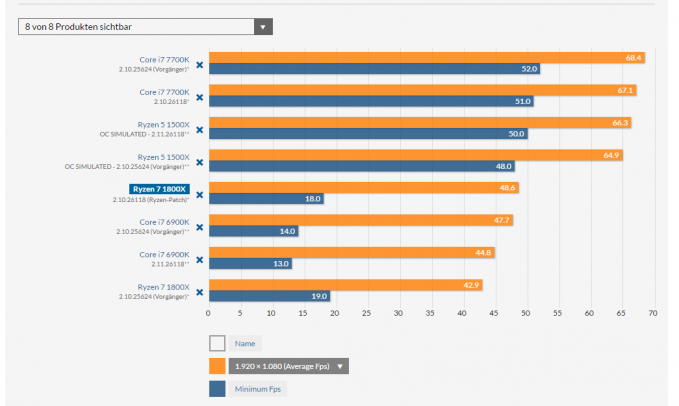
Oh, pcgameshardware.de updated the benchmark again, they found the problem. Their savegame, made with a 5820K, has extra dynamic lights on CPUs with 6 physical cores or above, but on 4 cores, it's disabled. This gave the 7700K a huge boost in performance.

When they simulated Ryzen 4 core, it was right on the heels of the 7700K.
 
It's not even Rise of the Tomb Raider only. This applies to other DX12 games as well. GTX + Ryzen 7 runs worse in DX12 due to the non-thread scaling of NV's drivers. Put in an AMD GPU, Ryzen's more core/threads scales better in DX12.


That's with an RX470 vs 1060 at low res. Note Ryzen 7 runs faster in DX12 with the RX 470, up to 30% faster, but on the 1060, it runs slower in DX12.
 
It is not one small area of the map. Please man, just watch the video towards the end. There are many levels where Ryzen 7 is now nipping the heels of the 7700K on AMD GPUs. But on GTX, its 20-35% behind.

NV's DX12 driver is broken for thread scaling in Rise of the Tomb Raider.

It's actually a shocker considering a lot of review sites tested DX12 games and only used NV GPUs (understandably, due to them being faster), actually resulted in a much worse performance for Ryzen 7 simply becaue of NV's driver bottlenecks for that API, not actually a CPU bottleneck at all. Amazing.

More evidence will emerge as people test more games like the The Division posted above. Hopefully some respectable, unbiased review sites will investigate properly since it is potentially a significant discovery. Maybe we are one step closer to solving the mystery of why Ryzen does so well in productivity yet poorly in games.

It's amazing that some are dismissing this as some sort of AMD fanboyism when they should be intrigued that perhaps the culprit isn't Ryzen after all but the gpu driver which is used when playing games.
 
Last edited:
No oversight and did I not say in my post existing and new platforms?
You also have turned this round to be an Nvidia issue when their products work with another CPU manufacturer platform and factors I mentioned could well be contributing to the issue.

Please explain the driver issue when it works perfectly on Intel (it has a lower fps than dual 480 as it is GPU bottlenecked at that point)?
Please explain if it is their implementation of DX12 why in some areas Nvidia gain great DX12 performance even in RoTR (again look at the result in Geothermal Valley that had 15% gains for Nvidia)? - context is that any improvements requires game code to align well with a GPU.
Please explain if their driver is the issue why then does AoTS in the past show the GTX1060 working as well as the 480 in AoTS with DX12 or why the 980ti outperforms Fury X on Intel CPUs?
And those are reference type cards not custom AIB where Nvidia really has a bit more performance.
Using Hardware Canucks as they use PresentMon.


A game well designed for AMD and shows how competitive Nvidia is with both trading blows with their respective tiers - context is Pascal and 980ti.

It is more than the Nvidia's driver and comes back to as I said in my previous post to being possibly similar to one of the below:
- something up with interraction between the AMD platform and Nvidia GPUs (which work perfectly fine on Intel and a GPU manufacturer does not know the workings of a CPU and also its IO interface at a core level, hint being it is beyond Nvidia and also involves AMD).
- something up with the platform when comparing a fast GPU using x16 to two slower GPUs in xfire using x8 PCIE

We know something unusual does happen with the IO aspect because it has been found that for some reason NVMe x4 SSD do not get the full throughput at more intense queue depth as they do on Intel's more recent platforms, now I am not making a big thing about this because as a consumer we would be hard pressed to hit that limit but it fits more with my context shows something is different at the PCIe/IO level.

So yeah AdoredTV jumped the gun and his conclusion was in the wrong place.
Like I said, this issue goes beyond Nvidia and requires both of them to work together to solve this headache, that does not necessarily happen for all games.
Cheers
Its not working on Intel either. You are tricked because specifically on 7700k 6 threads or less Intel GPU's there is an actual performance gain when going to DX12 in some games and or scenarios. The fact is that any loss shouldn't happen on either arch and the Radeon performance on both systems shows that.

Take a look at this

https://www.computerbase.de/2017-03.../#diagramm-battlefield-1-dx11-multiplayer-fps

vs

https://www.computerbase.de/2017-03.../#diagramm-battlefield-1-dx12-multiplayer-fps

The Ryzen on DX11 is challenging the 6950 in performance and only really loses out to the 6900 on DX11. But in DX 12 all the 8C+ CPU's take a hit in performance and the 7700k makes a decent jump in performance and huge jump to the top of the board as the 8c+ part lose performance and tumble down. Ryzen loses performance big time. DX12 is supposed to be the exact opposite of that.

What adored showed was that yes the particular area can show the strength or weakness of a particular arch. Both on CPU and GPU. But regardless of comparing 7700 and 1800x performance. That DX12 on the 480 has substantial gains under either CPU. On top of that what should not be happening is Ryzen losing tons of performance on every single situation where DX12 was enabled in RotTR. There are some parts where DX12 shines and some parts where DX12 doesn't do as well on the 7700. But even when the 7700 sees a marginal increase in performance the Ryzen performance tanks. You combine that with the BF1 performance from computerbase (while wishing they had 480 or Fury X numbers) and Adores 7700 and 1800x numbers with an 480 and you see what is happening. With Nvidia cards there is a thread performance cap that penalizes DX12 setups when it attempts to create more than 4c-6c worth of threads. Assuming Nvidia can't or won't fix this in time for r5 or Vega here is me setting my prediction in stone.

1. The dependent on the thread cap, the R5 either the 1500x or 1600x will beat the R1800x in DX12 performance. I am saying this understanding that the CCX penalty should be amplified. There may be still be other Ryzen specific I don't want to say issues so I will say missing Ryzen optimizations in the Nvidia driver, so I won't say they will catch any specific Intel CPU. I also said thread cap in reference to the Nvidia DX12 driver because after looking at the 7700k, 6850, and 6900 performance in BF1 in DX11 and DX12 I don't know where the thread penalty starts. If its more than 6 or if it's 4 and 6 just isn't penalized as much as 8 and 10. Its obvious that this penalty is worse on Ryzen than just cores, but since I was looking at Intel vs. Intel, I am doing the same for Ryzen. A Ryzen 4c or 6c at the same clocks should be worse with the CCX penalty than the 1800x. But if it they beat the 1800x it will show that the problem is how DX12 handles more than 4c worth of threads on an Nvidia card. I know one of the two will beat a 1800x I just don't know which.

2. Again assuming no fix from Nvidia, but with this they have time to fix it. If DX11 performance is within 10% of a 1080, Vega will mop the floor with a Titan X in DX12 regardless of CPU choice.
 
Have we finally come full circle? Are AMD fans now blaming NVIDIA for Ryzen's gaming issues? I thought I had seen it all, but boy was I wrong.
 
Have we finally come full circle? Are AMD fans now blaming NVIDIA for Ryzen's gaming issues? I thought I had seen it all, but boy was I wrong.
No that isn't what is happening. People like you are only looking at part of the picture. The R5 benches next week will prove the point. The point is that Nvidia has crappy DX12 performance with current drivers/hardware.

What AdoredTV noticed and what the Ryzen owners and interested party have been trying to figure out is why game performance has been so far behind expected single threaded performance in games. So Adored looked at an edge case, a game that had significantly worse performance than 7700K then you would expect. These types of results drag down the overall rankings in reviews. Meaning if you removed these games where the performance seems wrong you would end up with a better look at actual predictable performance. Now I don't support dropping performance numbers just because they don't match up expectations it is important to figure out why that performance didn't match up. Just like what computerbase.de did with ATOS or whatever it was called numbers, instead of going OMG look how terrible the R7 is compared to the 7700k, they found out it was because the new patch auto increased content and options based on a having a certain amount of cores or higher. The 7700k doesn't meet the requirements so it is given less work to do both CPU wise and GPU wise. What adored did was give a detailed analysis on why RotTR CPU performance should be ignored when dealing with Nvidia cards in DX12 and because there isn't a AMD card fast enough to bottleneck a 7700 all RotTR DX12 numbers should be ignored. While it is true that Ryzen takes a massive hit in performance compared to a 7700k with Nvidia's DX12 implementation, its obvious when just analyzing 7700k performance with both AMD and Nvidia GPU's that there is a problem at least in RotTR with DX12 and Nvidia cards. Now bit by bit people are going back through the reviews from earlier this month and also running their own tests and seeing the same thing. That is a performance penalty with more cores when DX12 is enabled with an Nvidia card. You can see it in computerbase links I put up above. The 6900k and 6950k both lose performance and the 7700k gains performance when DX12 is enabled. That is with Intel CPU's, not even talking about Ryzen.
 
Have we finally come full circle? Are AMD fans now blaming NVIDIA for Ryzen's gaming issues? I thought I had seen it all, but boy was I wrong.

I'm not really buying any of this yet, but I don't think it's far fetched to find some random companies drivers aren't optimized for a new arc or for a lot of threads outside of the gaming norm.

You obviously do or you're just looking for a fight instead of just taking it in and seeing what happens. New tech is supposed to be exciting and full of pitfalls and nuggets. Enjoy the moment instead of crying over it.
 
No that isn't what is happening. People like you are only looking at part of the picture. The R5 benches next week will prove the point. The point is that Nvidia has crappy DX12 performance with current drivers/hardware.

What AdoredTV noticed and what the Ryzen owners and interested party have been trying to figure out is why game performance has been so far behind expected single threaded performance in games. So Adored looked at an edge case, a game that had significantly worse performance than 7700K then you would expect. These types of results drag down the overall rankings in reviews. Meaning if you removed these games where the performance seems wrong you would end up with a better look at actual predictable performance. Now I don't support dropping performance numbers just because they don't match up expectations it is important to figure out why that performance didn't match up. Just like what computerbase.de did with ATOS or whatever it was called numbers, instead of going OMG look how terrible the R7 is compared to the 7700k, they found out it was because the new patch auto increased content and options based on a having a certain amount of cores or higher. The 7700k doesn't meet the requirements so it is given less work to do both CPU wise and GPU wise. What adored did was give a detailed analysis on why RotTR CPU performance should be ignored when dealing with Nvidia cards in DX12 and because there isn't a AMD card fast enough to bottleneck a 7700 all RotTR DX12 numbers should be ignored. While it is true that Ryzen takes a massive hit in performance compared to a 7700k with Nvidia's DX12 implementation, its obvious when just analyzing 7700k performance with both AMD and Nvidia GPU's that there is a problem at least in RotTR with DX12 and Nvidia cards. Now bit by bit people are going back through the reviews from earlier this month and also running their own tests and seeing the same thing. That is a performance penalty with more cores when DX12 is enabled with an Nvidia card. You can see it in computerbase links I put up above. The 6900k and 6950k both lose performance and the 7700k gains performance when DX12 is enabled. That is with Intel CPU's, not even talking about Ryzen.

Why would you think that a weaker version of Ryzen will outperform what's already out there? The R5's are weaker than the R7's (relitively speaking). And replacing an R7 with an R5 to prove this "edge case" might not prove anything we aren't already seeing. R7's and R5's are still Ryzen chips; A Ryzen is still a Ryzen. If we see the same results, why would you still think NVIDIA is the issue?

I'm not really buying any of this yet, but I don't think it's far fetched to find some random companies drivers aren't optimized for a new arc or for a lot of threads outside of the gaming norm.

You obviously do or you're just looking for a fight instead of just taking it in and seeing what happens. New tech is supposed to be exciting and full of pitfalls and nuggets. Enjoy the moment instead of crying over it.

If you want to say Motherboard firmware and drivers are an issue, I can accept they might be. If you want to say memory speed/timings are an issue, I can accept they might be. If you want to say the operating system and game code is an issue, I can accept they might be.

But now you want to blame the GPU and the GPU drivers? You're seriously trying to blame a separate computer component that works pretty straight forward concerning the CPU? Are you even kidding?...
 
But now you want to blame the GPU and the GPU drivers? You're seriously trying to blame a separate computer component that works pretty straight forward concerning the CPU? Are you even kidding?...
Strictly speaking it does stink of precisely driver implementation issue at this point. Or something of sort.

I mean, ultimately, in regards to performance, OS code, driver code and game code are all just that: code.

OS looks to not be that relevant, neither does game code seeing rx480 crossfire working as intended, only drivers left.
 
Strictly speaking it does stink of precisely driver implementation issue at this point. Or something of sort.

I mean, ultimately, in regards to performance, OS code, driver code and game code are all just that: code.

OS looks to not be that relevant, neither does game code seeing rx480 crossfire working as intended, only drivers left.

We have components working as intended, and they have been doing so for quite some time now. Along comes a new component and all of a sudden people start blaming was has been working fine until now.

So let me ask you this; why is anyone questioning the components that have been working fine until the release of Ryzen? Why is anyone blindly glaring passed the single constant at the center of all the issues so far?
 
We have components working as intended, and they have been doing so for quite some time now
Did you already forget all the regressions with nVidia in Dx12 titles? I did not. In fact, i even remember them as CPU regressions, and you can even find them in computerbase.de review still.

For all we care, nV driver may suffer from similar issue that appeared in Ashes of the singularity, since the latter was a product of compiler optimization.
 
Back
Top