Yea except that a V8 Corvette gets better Gas mileage than a Audi S4. OHHHHHHHHHHH!
So yea, LSX engines for life.
Right, because a turbo charged v6 with premium gas vs a stock v8 on rwd with unleaded is totally the same

![[H]ard|Forum](/styles/hardforum/xenforo/logo_dark.png)
Follow along with the video below to see how to install our site as a web app on your home screen.
Note: This feature may not be available in some browsers.
Yea except that a V8 Corvette gets better Gas mileage than a Audi S4. OHHHHHHHHHHH!
So yea, LSX engines for life.
Well, more fuel efficient, but diesel engines still have issues minimizing particular pollutants from their exhaust like much higher levels of soot and NOx: http://www.theicct.org/news/press-r...aust-emissions-modern-diesel-cars-seven-times
Part of the reason they are more efficient is that they run VERY lean compared to gasoline engines. They can run lean as there is little risk of pre-detonation with diesel fuel. That's part of the problem with a lot of diesel owners though is that they chip their diesel, because you can make more power out of a diesel by dumping in more fuel and running closer to stoichiometric air/fuel ratio, but when you do the diesels become SUPER POLUTERS, like BIG TIME!
The a-holes you see that are blowing huge smoke stacks out of their trucks are doing this for example (and sometimes taking out the particulate filters too), and IMO need to be anally raped with a rusty iron serving spoon.
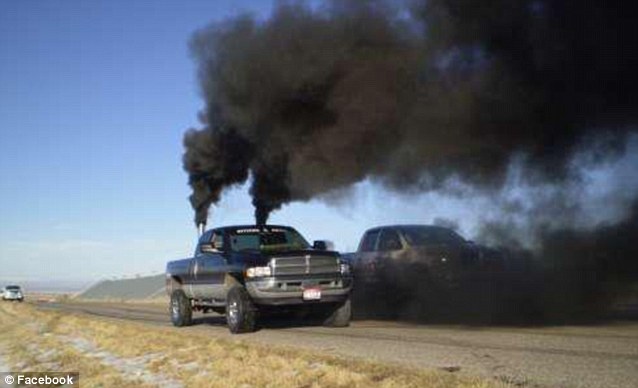
(feel free to slash tires, they are really expensive to replace)
That said, low emissions diesels are getting better every year, and all-inclusive they make more sense than hybrids for probably most of the United States where we travel on highways 90% of the time.
. Diesels run lean by design, that is the point in which the fuel/air ratio is in balance to where there is no unburnt fuel. So by nature they are stoich, even though they are "lean" (using less fuel for the amount of air). Also while producing more NOx, they put out less hydrocarbons, carbon monoxide, and carbon dioxide than gas vehicles. What you are seeing in that picture is not just a chipped diesel.... A diesel with a Edge Juice w/ Attitude even with the hot unlock will not produce that amount of smoke even if the guy is holding down the brake, torque locked it in 3rd, and slamming on the throttle unless he pulled off a coupler between the intake and turbo causing mass amounts of fuel to dump into the combustion chamber. So those trucks are obviously running aftermarket injectors with probably stacked chips and they're throttling with the brake on. As soon as you get on it and start moving, those trucks will lean out a substantial amount due to the turbo spooling up forcing more air into the combustion chamber. If you throw a chip onto an otherwise stock truck, you'll get a tiny initial puff of smoke then off they go, if they get on it hard from the start. Also did you know you can do the same crap with a gas car? Ever seen a 2 step launch control? A lot of those burn rich and lean out after the car begins to move and produce boost or take in more air. Finally if you run that rich for too long, you'll blowup your turbo or melt a piston. I am not condoning what they do, it is stupid. Now if you blow a shit ton of smoke out that leans out as you go and your truck is fast as fawk, that's ok in my book because it is tuned and there's basically nothing you can do about that initial puff of smoke. Torque locking and brake standing are both dumb when all your doing is blowing black smoke.You realize you're rolling your eyes at me when you're the one that needs to learn to read..... Mmmmmmhmm.Actually becoming a "super polluter" would mean he is running rich
Reliability of the motor goes down quite a bit if you start cranking up the temps with current materials and methods of manufacture. Really big problem is the seals and lubricants IIRC. They really don't like high temps.How about making the engines run hotter?
I know its not a new idea, but how about implementing it?
Plus, a hot engine isn't a good thing. You just want the heat contained where its supposed to be, and ceramic coatings work for that.Reliability of the motor goes down quite a bit if you start cranking up the temps with current materials and methods of manufacture. Really big problem is the seals and lubricants IIRC. They really don't like high temps.
You realize you're rolling your eyes at me when you're the one that needs to learn to read..... Mmmmmmhmm.
1) That's exactly what I said, diesels are designed to run lean, but you can modify them to run closer to stoich which puts out tons of soot.
2) No, they aren't "by nature stoich". Ugh, you need to look up the definition of stoichiometric.
And I don't know why you're confused as I clearly explained it; they run lean which they have to because while you can get more power at stoichiometric (duh, by definition) air-fuel ratios, you don't do that because diesel doesn't mix or burn as quickly and cleanly as gasoline and so you end up with pollutants and soot.
Regarding options for running rich, I'm sure there are many ways to screw with emissions equipment, but a chip is a simple option to trick the ECU into thinking you're running leaner than you are and dumping in too much fuel. How its done isn't really important, and yes obviously its going to shorten the life of the vehicle covering everything in soot. Ideally it would shorten the life of the driver, preferably with ass cancer.
You realize you're rolling your eyes at me when you're the one that needs to learn to read..... Mmmmmmhmm.
1) That's exactly what I said, diesels are designed to run lean, but you can modify them to run closer to stoich which puts out tons of soot.
2) No, they aren't "by nature stoich". Ugh, you need to look up the definition of stoichiometric.
And I don't know why you're confused as I clearly explained it; they run lean which they have to because while you can get more power at stoichiometric (duh, by definition) air-fuel ratios, you don't do that because diesel doesn't mix or burn as quickly and cleanly as gasoline and so you end up with pollutants and soot.
Regarding options for running rich, I'm sure there are many ways to screw with emissions equipment, but a chip is a simple option to trick the ECU into thinking you're running leaner than you are and dumping in too much fuel. How its done isn't really important, and yes obviously its going to shorten the life of the vehicle covering everything in soot. Ideally it would shorten the life of the driver, preferably with ass cancer.
You realize you're rolling your eyes at me when you're the one that needs to learn to read..... Mmmmmmhmm.
1) That's exactly what I said, diesels are designed to run lean, but you can modify them to run closer to stoich which puts out tons of soot.
2) No, they aren't "by nature stoich". Ugh, you need to look up the definition of stoichiometric.
And I don't know why you're confused as I clearly explained it; they run lean which they have to because while you can get more power at stoichiometric (duh, by definition) air-fuel ratios, you don't do that because diesel doesn't mix or burn as quickly and cleanly as gasoline and so you end up with pollutants and soot.
Regarding options for running rich, I'm sure there are many ways to screw with emissions equipment, but a chip is a simple option to trick the ECU into thinking you're running leaner than you are and dumping in too much fuel. How its done isn't really important, and yes obviously its going to shorten the life of the vehicle covering everything in soot. Ideally it would shorten the life of the driver, preferably with ass cancer.
Look, I already pointed out that you are wrong, and recommended you look up the definition. Repeating yourself is not a debate tactic.Stoich is the combustion of all fuels. By design diesel engines are generally stoich and can remain so even when chipped. If the proper amount of air is delivered to the combustion chamber to allow combustion of all the fuel then by definition the engine is stoich.
Wikipedia said:Gasoline engines can run at stoichiometric air-to-fuel ratio, because gasoline is quite volatile and is mixed (sprayed or carburetted) with the air prior to ignition. Diesel engines, in contrast, run lean, with more air available than simple stoichiometry would require. Diesel fuel is less volatile and is effectively burned as it is injected, leaving less time for evaporation and mixing. Thus, it would form soot (black smoke) at stoichiometric ratio.
Cool story, what does that at all have to do with the conversation? Are you implying that you can't control the air-fuel ratio with a chip? I wonder how I'm able to do that on my laptop, and run it ridiculously rich on stock injectors/fuel pump.My diesel is chipped and even running full tilt it will barely haze for a second at launch until the turbo catches up. It's all derived from a proper air to fuel ratio. My truck also happens to lack any sort of EGR emissions system as well as the catalytic converter, Straight air in through the filter, combustion, straight out through 4" of 'Murica straight pipe.
Soot is soot, and what does that have to do with rolling coal? The only thing I can figure out here is you really didn't read my post and went on a knee-jerk defensive reaction because you drive a chipped diesel truck and felt attacked.The majority of soot you see pouring out from trucks, busses, big rigs, etc is very temporary until the turbo has time to spool up and provide more air. Even with these occasional expulsions of soot, diesel engines are still far more efficient than gasoline engines.
Ugh, stupid lack of edit "C5 heads", I've never owned a C6.
How about a Corvette C5 vs Prius? Or a C6 with turbos getting 42 MPG? Bow before your v8 master race.Right, because a turbo charged v6 with premium gas vs a stock v8 on rwd with unleaded is totally the same
Look, I already pointed out that you are wrong, and recommended you look up the definition. Repeating yourself is not a debate tactic.
http://en.wikipedia.org/wiki/Stoichiometry
http://en.wikipedia.org/wiki/Air–fuel_ratio
Stoichiometric air fuel ratios involve the theoretical mixture of air to fuel ratio to burn all fuel WHILE USING ALL THE AIR in a chemical equation. Air is a reagent. It is the perfect mixture of fuel and air, to where both are consumed, but no engine operates on such ideals for obvious reasons, and a lean burning engine isn't stoichiometric for obvious reasons if you know what the definition of the word is. Heck, even the Wiki has a line almost exactly what we're talking about:
How does one coat the heats with ceramic? Titanium Ceramic Coating? Wouldn't it be better to just get better stronger heads? There's so many for the LSX engines.
How about a Corvette C5 vs Prius? Or a C6 with turbos getting 42 MPG? Bow before your v8 master race.
Why care about hybrids and lasers when you could just stick a LSX engine and get great gas mileage?
Apples and oranges when comparing two different cars with very different drag coefficients.
I've explained this to you and given you links. AIR IS A REAGENT. What part of that is confusing to you? If you have burned all the fuel and have excess air, you are running LEAN. If you have used all the air and have excess fuel you are running RICH. If you use all the air and fuel, you have a stoichiometric ratio. This isn't rocket science, yet you post "lean" and "stoichiometric" in the same sentence. *bangs head on table*Just so you know, I never had the definition of stoich wrong. In fact I stated it in my last post, the exact definition. One thing about diesels is their lean is actually stoich because if they were at the stoichiometric ratio, the engine doesn't allow for the full burning of the fuel, which is actually contradictory to what stoich means. " If exactly enough air is provided to completely burn ALL of the fuel, the ratio is known as the stoichiometric mixture, often abbreviated to stoic. (wikipedia)". Because stoich on a diesel does not allow the burning of all the fuel, there is excess air provided to burn ALL the fuel. So a diesels stoich is actually lean.
http://en.wikipedia.org/wiki/Air–fuel_ratio
Its a thermal barrier, not so much done for "strength". I had em done by GTP here in Houston: http://www.gtp-racing.com/upgrades.htmlHow does one coat the heats with ceramic? Titanium Ceramic Coating? Wouldn't it be better to just get better stronger heads? There's so many for the LSX engines.

I know dick all about lasers, but if lasers can cut through steel, then certainly they can cut through a thin film of carbon buildup.As a laser engineer I already thought of this year or two ago.
Problem is modern engines have oil/crap recirculating into your cylinder and the optics get dirty.
They can't get modern direct injection petrol engines to work without major carbon issues over long term use as it is, so I'm skeptical they can get this going any time soon with dirty, 100 year old dino tech.

If you use all the air and fuel
.Damn you're right. TURBO EVERYTHING!
No offense, but you just went "full retard". You know how the academy frowns upon that.
Take even the most basic level physics class, and you'll understand how its primarily the heat energy that you are capturing, not "airflow". In fact, what exactly do you think is causing the gasses to rush out of the engine at such a rapid velocity? That they are being PUSHED by the pistons? Well, technically a tiny bit, but peak exhaust pressure is right when the exhaust valve is opened rather than an even push from the cylinder through its stroke, which actually contributes very little. Its the heat causing rapid expansion of the gasses, and the energy extracted by the turbocharger is why a turboed car's exhaust is cooler than a naturally aspirated engine, all else equal.
So the cliffs notes is that its the temperature and pressure drop across a turbine that represents almost all of the energy captured, rather than the minimal energy such as say your blowing onto a pinwheel.
Understanding this very basic concept is why its so important to keep the turbocharger as close to the exhaust ports as possible, and that thermal wrapping of the exhaust is sometimes used to ensure no heat loss before the turbocharger. Otherwise if it were just about "airflow", it wouldn't matter if you mounted the turbocharger in the middle of your car way behind the catalytic converter, since the total exhaust volume exiting the vehicle won't change. But we know that there is heat loss, which is why a turbo mounted too far back won't make much boost and would be extremely laggy trying to build up enough pressure.
I've said this before, but you're ignoring it. Its a chemical equation, and that chemical equation can't occur within the confines of a diesel engine in which you have insufficient time and imperfect air-fuel mixture occurring. However, as to the original comment, you can increase power by increasing fuel and running richer, since diesels are designed to run lean to ensure all fuel is burned on every stroke. That is why diesel drag tractors let out massive plumes of smoke.I still think you are applying gasser ideology to diesels. Because like you said, and like we both know, a diesel, when ran "stoich" will not burn all the fuel. So how can it be stoich, if like you said, it uses all the fuel as well?
EXACTLY THIS, the turbine extracts the energy at its core in the form of heat and pressure drop of the exhaust gases. I'm pretty sure I said just that at some point, hold on:A pressure and temperature drop occurs (expansion) across the turbine (7),
which harnesses the exhaust gas energy to provide the power necessary to drive the
compressor
Ducman69 said:So the cliffs notes is that its the temperature and pressure drop across a turbine that represents almost all of the energy captured, rather than the minimal energy such as say your blowing onto a pinwheel.
That statement can be read different ways.A pressure and temperature drop occurs (expansion) across the turbine (7),
which harnesses the exhaust gas’ energy to provide the power necessary to drive the
compressor