• Some users have recently had their accounts hijacked. It seems that the now defunct EVGA forums might have compromised your password there and seems many are using the same PW here. We would suggest you UPDATE YOUR PASSWORD and TURN ON 2FA for your account here to further secure it. None of the compromised accounts had 2FA turned on.
    Once you have enabled 2FA, your account will be updated soon to show a badge, letting other members know that you use 2FA to protect your account. This should be beneficial for everyone that uses FSFT.

Data center in Space

Not to mention most of the sunlight we receive is infrared, and our atmosphere does block some chunks of it, and those longer infrared bands really isn't particularly useful for solar power, and to a lesser extent UV radiation as well.

You need that infrared in space anyway to toss it away/radiate/induce/create cooling as discussed earlier in the thread, while as you say on Earth it's useless/detrimental/causes heat.
 
You need that infrared in space anyway to toss it away/radiate/induce/create cooling as discussed earlier in the thread, while as you say on Earth it's useless.
?? You need it to toss it away? That's not how radiative cooling works.

Yes, it cools by dumping radiation, mostly IR, but that is in no way facilitated by the IR coming from the Sun, quite the opposite actually as that is IR absorbed, although usually they minimize the total cooling surface area not facing the Sun
 
?? You need it to toss it away? That's not how radiative cooling works.

Yes, it cools by dumping radiation, mostly IR, but that is in no way facilitated by the IR coming from the Sun, quite the opposite actually as that is IR absorbed, although usually they minimize the total cooling surface area not facing the Sun

Radiating away=tossing it away

It's not an active process but passive, yes - just speaking 'broadly'

Was pointing out how in space you NEED IR radiation (not from Sun but as part of the design/to cool) while on Earth it's largely unwanted overall (and not part of the cooling process/design) because we have other cooling methods not available/possible in space

Solar panel design/use in space=/=solar panel design/use on Earth was the point

One you design to reject IR (Earth), one you design for emission of IR (space)
 
Last edited:
Idk if anyone has actually done the math earlier in the thread, but radiating heat in space is basic stefan boltzmann law.
Just solve for A and set the negative T to zero.
Have fun noticing that you’ll need a lot of surface area.
 
Idk if anyone has actually done the math earlier in the thread, but radiating heat in space is basic stefan boltzmann law.
Just solve for A and set the negative T to zero.
Have fun noticing that you’ll need a lot of surface area.

This is where things like LDR (liquid droplet radiators) and advancements in materials science (Edit: not just for cooling/the overall structure/radiators, but for the electronics/chips/computers in the DC to handle higher heat too etc) come in along with ideas of 'breaking up the datacenter into swarms' instead of an all-in-one DC.

Again, no one is saying we're gonna move away from datacenters on Earth to space tomorrow, but you have to start somewhere/sometime to achieve that - and that's the part we're at now. Which requires 'practice, practice, practice' = 'actually doing the thing', whether doing it well (efficient, cost or otherwise) or not. Then, try again.

All the theory and math in the world only takes you so far until you have to move onto practical and experiments, to steal a (butchered) line/idea from the Oppenheimer movie 😁
 
Last edited:
This is where things like LDR (liquid droplet radiators) and advancements in materials science (Edit: not just for cooling/the overall structure/radiators, but for the electronics/chips/computers in the DC to handle higher heat too etc) come in along with ideas of 'breaking up the datacenter into swarms' instead of an all-in-one DC.

Again, no one is saying we're gonna move away from datacenters on Earth to space tomorrow, but you have to start somewhere/sometime to achieve that - and that's the part we're at now. Which requires 'practice, practice, practice' = 'actually doing the thing', whether doing it well (efficient, cost or otherwise) or not. Then, try again.

All the theory and math in the world only takes you so far until you have to move onto practical and experiments, to steal a (butchered) line/idea from the Oppenheimer movie 😁

“Sophia Space raises $10M seed to demo novel space computers​


As space companies itch to push the most advanced chips into orbit, the problem of cooling those high-powered processors is top of mind.
“It’s cold in space … [but] there’s no airflow, and so the only way to dissipate is through conduction,” Nvidia CEO Jensen Huang said when asked about space-based data centers during his firm’s most recent earnings call.“

https://techcrunch.com/2026/02/26/sophia-space-raises-10m-seed-to-demo-novel-space-computers/
 
“As surging AI and compute demand pushes terrestrial data centers to their limit, space-based data centers can harness infinitely abundant solar energy in orbit thanks to Rocket Lab’s rapidly scalable silicon solar arrays

LONG BEACH, Calif., Feb. 26, 2026 (GLOBE NEWSWIRE) -- Rocket Lab Corporation (Nasdaq: RKLB) (“Rocket Lab” or “the Company”), a global leader in launch services and space systems, today announced the introduction of advanced silicon solar arrays designed to power gigawatt-scale space-based data centers spanning kilometers in orbit.“

https://finance.yahoo.com/news/rocket-lab-introduces-advanced-silicon-210800417.html
 

“Sophia Space raises $10M seed to demo novel space computers​


As space companies itch to push the most advanced chips into orbit, the problem of cooling those high-powered processors is top of mind.
“It’s cold in space … [but] there’s no airflow, and so the only way to dissipate is through conduction,” Nvidia CEO Jensen Huang said when asked about space-based data centers during his firm’s most recent earnings call.“

https://techcrunch.com/2026/02/26/sophia-space-raises-10m-seed-to-demo-novel-space-computers/
Fucking wow.. give me money to show computers work in space.
 
Fucking wow.. give me money to show computers work in space.
https://www.baesystems.com/en-us/who-we-are/electronic-systems/c4isr/space-electronics

https://en.wikipedia.org/wiki/RAD750

1772235209679.png


i like the notion of the BAE RAD750 IBM Power processor, been wanting to collect a singular 1 unit
 
i like the notion of the BAE RAD750 IBM Power processor, been wanting to collect a singular 1 unit

Better to collect 3 units, so they can run in lockstep (is that possible on Power?) and decide conflicts by majority. More appropriate for space equipment.
 
Better to collect 3 units, so they can run in lockstep (is that possible on Power?) and decide conflicts by majority. More appropriate for space equipment.
i think they’re insanely expensive

“Aug 13, 2012 — The RAD750 system has a price that is comparable to the RAD6000 which is US$200,000 per board (per 2002 reference).”
 
Better to collect 3 units, so they can run in lockstep (is that possible on Power?) and decide conflicts by majority. More appropriate for space equipment.
We have a LOT of RAD750s sitting in geo orbit as we speak. They typically have a single backup unit that basically dups the state and can immediately take over if there's a failure. But to my knowledge and experience, this is very rarely needed. These are 500m just for the birds, and they usually get launched with insurance so you can be sure the system is extremely reliant. (Source: worked on ground software verification for the SSL Omega 3 DHS for a stint).
 
i think they’re insanely expensive

“Aug 13, 2012 — The RAD750 system has a price that is comparable to the RAD6000 which is US$200,000 per board (per 2002 reference).”
Yes, this is accurate. And the box is always custom milled titanium enclosures, so thats a mint too. But relatively cheap for a satellite.
 
  • Like
Reactions: erek
like this

“Constant Space Launches Turning Earth’s Atmosphere Into a “Crematorium,” Scientists Say​

Experts warn that collisions between space junk could cascade out of control and cause the entire region to collapse into a destructive vortex of swirling debris. This scenario, called Kessler syndrome, would turn the Earth’s orbit into a dangerous minefield that could set back spaceflight for decades.

In the meantime, falling space junk could become a lethal threat for us on the ground, with increasing reports of large chunks of satellites and spacecraft surviving their fiery plunge instead of disintegrating as intended.”

https://futurism.com/space/space-launches-atmosphere-crematorium
 

“Constant Space Launches Turning Earth’s Atmosphere Into a “Crematorium,” Scientists Say​

Experts warn that collisions between space junk could cascade out of control and cause the entire region to collapse into a destructive vortex of swirling debris. This scenario, called Kessler syndrome, would turn the Earth’s orbit into a dangerous minefield that could set back spaceflight for decades.

In the meantime, falling space junk could become a lethal threat for us on the ground, with increasing reports of large chunks of satellites and spacecraft surviving their fiery plunge instead of disintegrating as intended.”

https://futurism.com/space/space-launches-atmosphere-crematorium
Space Force...I assume... should be tracking all of it and making risk mitigation plans, etc..?
 

“Who needs data centers in space when they can float offshore?​


The power crunch for AI data centers has gotten so severe that people — not just Elon Musk — are talking about launching servers into spaceso they can access solar power 24/7.
One startup thinks the ocean is a better place for them. Offshore wind developer Aikido is planning to submerge a 100-kilowatt demonstration data center off the coast of Norway this year. The small unit will live in the submerged pods of a floating offshore wind turbine.


If all goes well, the company hopes to build a larger version to deploy off the coast of the U.K. in 2028. That model will sport a 15 megawatt to 18 megawatt turbine that will feed a 10 megawatt to 12 megawatt data center.
The move offshore could solve a few challenges. Proximity to power is an obvious one, since the source will sit overhead. Winds offshore are more consistent than onshore, and a modest battery could bridge any lulls.
Submerged data centers could eliminate concerns from NIMBY (“not in my backyard”) groups who oppose data centers near their properties due to noise and and pollution concerns.
Lastly, by floating in cold seawater, cooling the servers would be a simpler proposition. (Cooling is one particularly vexing issue for orbital data centers, since they need to employ different techniques in the vacuum of space.)“

https://techcrunch.com/2026/03/04/who-needs-data-centers-in-space-when-they-can-float-offshore/
 
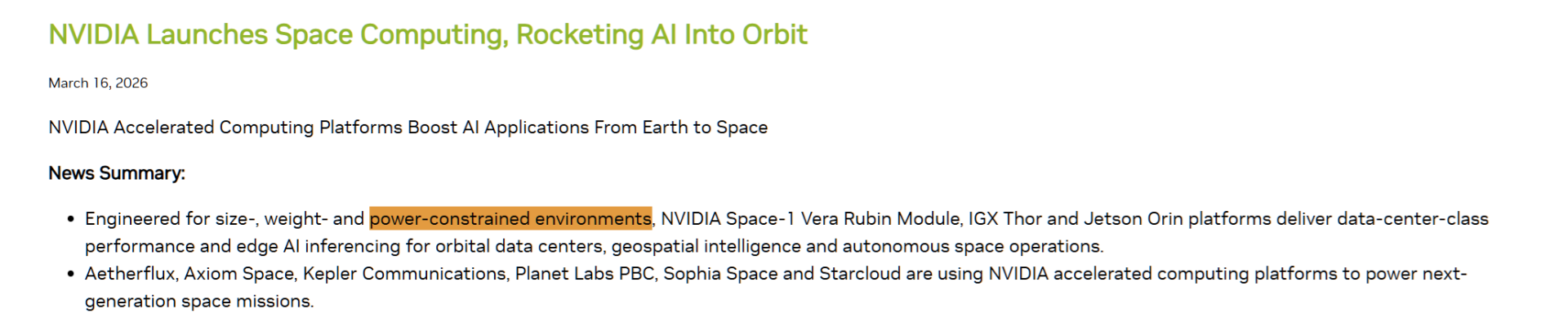
“Nvidia announces Vera Rubin Space Module — up to 25x the AI compute of H100 for orbital data centers”

rad hardened or what?


https://x.com/tomshardware/status/2033636307977801974
Did they lower the power usage? Starcloud, one of the many "space data center" startups did launch an H100 into space and use it to train a tiny LLM. However they couldn't run it all the time, it kept overheating and they couldn't radiate heat away fast enough.
 
  • Like
Reactions: erek
like this
I guess we'll see how it goes. It still seems really stupid to me, the size of radiators and solar arrays that would be needed for anything with big amounts of compute are just stupid, like multiple square km which in addition to being expensive and a logistical nightmare and a huge target for space debris.

I understand, but as mentioned elsewhere in this thread - how do you get better at something without 'practice, practice, practice/faking it till you make it'?
 
  • Like
Reactions: erek
like this
I understand, but as mentioned elsewhere in this thread - how do you get better at something without 'practice, practice, practice/faking it till you make it'?
True, my question is just if this is worth getting better at? Like I could understand the argument if we just flat out didn't have any more land, if the problem was you just couldn't get the space you need to build a DC anywhere. However that's not the case, the issues they are running in to are people don't want to put up with the noise and they gobble insane power. Ok... Well both of these are solvable on Earth for less money than getting them in space. For the noise, put that shit out in the middle of nowhere. There's lots of land available, usually quite cheap, that's not near anything. The reason they don't? More expensive to construct and run. The further away from infrastructure something is, the more your build costs are, and of course the more it costs to get employees to go and work there. Ok... but both of those are true for space but even more so. The launch costs make it WAY more expensive than anything you'd be talking on Earth and basically you have to build it all self-contained, nobody is coming to service it. So a "middle of nowhere" on-Earth DC wins there.

Power is another reason to build near population centers, and another thing you don't get in space. Ok sure, you get more solar energy. However, as mentioned, you have to deal with the waste heat which is way harder and increases the cost and area. On Earth, you'd need more solar panels and batteries, but again, you don't need to launch those in space and you don't need massive radiators to cool shit. Likewise you can get power in remote locations, you have to pay the electric company to run it, it isn't cheap, but it isn't out of the question.

I'm just not seeing the reason. An analysis I saw, which I think may be accurate, from Patrick Boyle thinks it is mostly Elon trying to justify his bundling of TwitterAI and SpaceX together and IPOing the thing. What an AI company and a rocket company have to do with each other is a real stretch... unless you are talking about putting AI datacenters in space then it makes (a little) more sense. I just remain unconvinced that this is actually economically feasible/smart and not just some pie-in-the-sky techbro shit. However I am prepared to be proven wrong.
 
True, my question is just if this is worth getting better at? Like I could understand the argument if we just flat out didn't have any more land, if the problem was you just couldn't get the space you need to build a DC anywhere. However that's not the case, the issues they are running in to are people don't want to put up with the noise and they gobble insane power. Ok... Well both of these are solvable on Earth for less money than getting them in space. For the noise, put that shit out in the middle of nowhere. There's lots of land available, usually quite cheap, that's not near anything. The reason they don't? More expensive to construct and run. The further away from infrastructure something is, the more your build costs are, and of course the more it costs to get employees to go and work there. Ok... but both of those are true for space but even more so. The launch costs make it WAY more expensive than anything you'd be talking on Earth and basically you have to build it all self-contained, nobody is coming to service it. So a "middle of nowhere" on-Earth DC wins there.

Power is another reason to build near population centers, and another thing you don't get in space. Ok sure, you get more solar energy. However, as mentioned, you have to deal with the waste heat which is way harder and increases the cost and area. On Earth, you'd need more solar panels and batteries, but again, you don't need to launch those in space and you don't need massive radiators to cool shit. Likewise you can get power in remote locations, you have to pay the electric company to run it, it isn't cheap, but it isn't out of the question.

I'm just not seeing the reason. An analysis I saw, which I think may be accurate, from Patrick Boyle thinks it is mostly Elon trying to justify his bundling of TwitterAI and SpaceX together and IPOing the thing. What an AI company and a rocket company have to do with each other is a real stretch... unless you are talking about putting AI datacenters in space then it makes (a little) more sense. I just remain unconvinced that this is actually economically feasible/smart and not just some pie-in-the-sky techbro shit. However I am prepared to be proven wrong.

As mentioned earlier on in thread IIRC

1) sun is free unlimited never ending power (combined with sun sync orbit, and space panels better/more efficient than Earth panels)

2) space massive heatsink to dump all the heat, no water etc needed (part of the allure of practicing over and over/developing tech/materials/etc to get it right)

3) even if more inhospitable to humans, space is less hostile to equipment than Earth is (storms, earthquakes, etc), even for all the still existing dangers in space for equipment (radiation, space debris, etc)

There's also the security aspect - if you got secrets you wanna keep/sensitive equipment - where's a better place to store them/it - on Earth with all the humans already, or space where as mentioned it's more difficult for them to be/operate in?
 
As mentioned earlier on in thread IIRC
Again the issue comes down to cost though. I understand the theory, but in practice all those run into the fact that it costs a whole lot more to get the stuff in space. So when it comes to power form the sun, it is all about the increased cost of getting it in space vs that you do need more panels (and batteries) on Earth. It's still free here, and solar is well worth it economically, which is why you see electric companies rolling out solar plants.

If it is cheaper in space, I'd like to see the cost analysis: What would it cost to build a solar farm, batteries, and cooling infrastructure (ACs, ground source loops, etc) for a DC on Earth, including buying the land, vs launching all the shit in space. If it isn't at least close, like within 50%, then I'm failing to see the point. My back of the napkin math has it being at least 4x the cost.

There's also the security aspect - if you got secrets you wanna keep/sensitive equipment - where's a better place to store them/it - on Earth with all the humans already, or space where as mentioned it's more difficult for them to be/operate in?
I mean... yes and no. For those secrets to be of any use, they have to be accessible from Earth, and your company, its employees, and you are still on Earth which means that people who want at them have paths in. Getting at secrets has not been an operation of sneaking into datacenters and exfiltrating data. They are actually fairly easy to secure since few people need access. It has been through hacking, phishing, bribery, etc. Being in space helps with none of that unless the data is only there, and there's no way to access it remotely in which case... why have it?
 
Again the issue comes down to cost though. I understand the theory, but in practice all those run into the fact that it costs a whole lot more to get the stuff in space. So when it comes to power form the sun, it is all about the increased cost of getting it in space vs that you do need more panels (and batteries) on Earth. It's still free here, and solar is well worth it economically, which is why you see electric companies rolling out solar plants.

If it is cheaper in space, I'd like to see the cost analysis: What would it cost to build a solar farm, batteries, and cooling infrastructure (ACs, ground source loops, etc) for a DC on Earth, including buying the land, vs launching all the shit in space. If it isn't at least close, like within 50%, then I'm failing to see the point. My back of the napkin math has it being at least 4x the cost.


I mean... yes and no. For those secrets to be of any use, they have to be accessible from Earth, and your company, its employees, and you are still on Earth which means that people who want at them have paths in. Getting at secrets has not been an operation of sneaking into datacenters and exfiltrating data. They are actually fairly easy to secure since few people need access. It has been through hacking, phishing, bribery, etc. Being in space helps with none of that unless the data is only there, and there's no way to access it remotely in which case... why have it?

Printing press (and all things) was expensive at first - again this is just part of 'practice, practice, practice' - how do you cut costs without figuring out how to do it then scaling to cut costs? Answer/solution not just gonna randomly fall into your lap one day when you're not working on/at it. That's why all these companies are investing the money they are/doing it as we see in the thread. To get there from here you have to go/do. It's the only way.

Don't ask me to do any math either (long or napkin😁) - here's the quick AI answer:

1773797225369.png


People who access info from DC on Earth aren't going up to each server or even the DC/building every time to access a file (not talking about techs), they do it remotely - encryptions/signal transfers/etc all that still works and applies with space as we know from all the info we send back and forth already to stuff in space (even with top secret info/satellites/equipment).
 
I understand, but as mentioned elsewhere in this thread - how do you get better at something without 'practice, practice, practice/faking it till you make it'?
The problem is practice, practice, practice in this case makes space junk.
 
https://ntrs.nasa.gov/api/citations/20130001608/downloads/20130001608.pdf

Heat problem seems solvable. It would not only be useful for space data centers.
Getting up to space is still very expensive.

“Jeff Bezos' rocket company Blue Origin applies to launch 51,000 datacenter satellites​


‘Project Sunrise’ needs a network that doesn’t exist, a rocket that’s hardly flown, and FCC approval​


Jeff Bezos’ space company Blue Origin has applied to launch up to 51,600 datacenter satellites.
A Thursday filing argues that the US Federal Communications Commission should approve Blue Origin’s plans because “insatiable demand for AI workloads” means orbiting servers represent “a complement to terrestrial infrastructure by introducing a new compute tier that operates independently of Earth-based constraints.”
Blue Origin also argues that datacenters in space will “enable U.S. companies developing and using AI to flourish, accelerating breakthroughs in machine learning, autonomous systems, and predictive analytics in support of broad societal benefit.”“

https://www.theregister.com/2026/03/20/blue_origin_project_sunrise_orbital_datacenter/
 

“Jeff Bezos’ Blue Origin enters the space data center game​


Blue Origin, the space conglomerate founded by Amazon chair Jeff Bezos, has asked the U.S. government for permission to launch a network of more than 50,000 satellites that will act as a data center in orbit.
In a March 19 document filed with the Federal Communications Commission (FCC), Blue Origin’s attorneys described “Project Sunrise” as a network of spacecraft that will perform advanced computation in orbit to “ease mounting pressure on U.S. communities and natural resources by shifting energy — and water-intensive compute away from terrestrial data centers.”“

https://techcrunch.com/2026/03/20/jeff-bezos-blue-origin-enters-the-space-data-center-game/
 
  • Like
Reactions: erek
like this

“From satellites to space data centers: Why low earth orbit is attracting billions in investment​


KEY POINTS
  • From Nvidia to Elon Musk’s SpaceX, Big Tech is betting big on a new layer of critical infrastructure that’s emerging above our heads.
  • Low earth orbit underpins global navigation, telecommunications, defense and worldwide connectivity and is seeing a flood of investment.
  • More than $45 billion worth of investment in the sector was recorded in 2025, up sharply from just under $25 billion in 2024, according to Space IQ.“
https://www.cnbc.com/2026/03/22/why-low-earth-orbit-is-attracting-billions-in-investment.html
 

“From satellites to space data centers: Why low earth orbit is attracting billions in investment​


KEY POINTS
  • From Nvidia to Elon Musk’s SpaceX, Big Tech is betting big on a new layer of critical infrastructure that’s emerging above our heads.
  • Low earth orbit underpins global navigation, telecommunications, defense and worldwide connectivity and is seeing a flood of investment.
  • More than $45 billion worth of investment in the sector was recorded in 2025, up sharply from just under $25 billion in 2024, according to Space IQ.“
https://www.cnbc.com/2026/03/22/why-low-earth-orbit-is-attracting-billions-in-investment.html
That interest is in stuff low low eart orbit VERY hard to jam navigation systems, because it is getting easy to jam the GPS system.
So military precison, not datacenters in space, but it is a nice "red herring", just like "UFO's" was a nice "red herring" to cover up Project Mogul.
 
That interest is in stuff low low eart orbit VERY hard to jam navigation systems, because it is getting easy to jam the GPS system.
So military precison, not datacenters in space, but it is a nice "red herring", just like "UFO's" was a nice "red herring" to cover up Project Mogul.

“SpaceX offers details on orbital data center satellites​

A SpaceX illustration showing the Starship V3 rocket on the same scale as its planned AI Sat Mini orbital data center spacecraft. Credit: SpaceX
WASHINGTON — SpaceX Chief Executive Elon Musk revealed more technical, but not financial, details about his company’s plans to deploy an orbital data center constellation.
At a March 21 event in Austin, Texas, Musk outlined an initiative by SpaceX, along with automaker Tesla and artificial intelligence company xAI — also run by Musk — to massively increase production of high-end computer chips needed for both terrestrial and space applications.
The Terafab project seeks to produce one terawatt of processors annually, which Musk said is 50 times the combined production rate of all manufacturers of chips used today in advanced applications such as AI.
Those processors, he said, are the “missing ingredient” in his plans to deploy a large constellation of satellites to serve as an orbital data center.“

https://spacenews.com/spacex-offers-details-on-orbital-data-center-satellites/
 

“SpaceX hits back at Amazon in orbital datacenter dispute​


In space, no one can hear you being petty​


SpaceX has fired back at Amazon with a letter to the US telecoms regulator, after Amazon objected to its plans for orbiting datacenters.
The Elon Musk-owned biz delivered a missive to the Federal Communications Commission(FCC) on Friday, noting that rival space company Blue Origin has filed an application to launch up to 51,600 data processing satellitesinto low Earth orbit.
Blue Origin is owned by billionaire Amazon founder Jeff Bezos. Earlier this month, Amazon filed an objection with the FCC against SpaceX's own application asking for permission to launch an orbiting cluster of datacenters.“

https://www.theregister.com/2026/03/23/spacex_amazon_orbital_datacenters/


"Orbital data centers, part 1​

1774385418950.png

Will there really be an energy crunch?​

Proponents of space-based data centers seem convinced that energy costs will only go up. But the fusion industry is growing, there are new nuclear initiatives such as Bill Gates’ TerraPower, and there is no shortage of hot, sunny places to put down solar farms.
McCalip is not sold on the idea that energy will be a limiting factor for terrestrial data centers. He believes that capital markets will respond to rising electricity demand and prices. He also has a hard time envisioning states like Texas throwing up regulatory barriers before expanding data centers. Some states may block them, but others will find the economic boon hard to resist.
For all of this, McCalip hedged a bit in our interview. He agreed that global demand for computing power will only increase and that decision-makers are generally underestimating the need for future computing power. Moreover, the ratio of inference workloads relative to training workloads—the type of work orbital data centers will optimize for—should increase over time.
“This is not physically impossible; it’s only a question of whether this is a rational thing to scale up economically,” McCalip said. “The answer is it’s really close. And if you own both sides of the equation, SpaceX and xAI, it’s not a terrible place to be. I wouldn’t bet against Elon.”
Yet betting on Elon also requires a giant leap of faith.
The third part of this series will dive deeper into detailed cost estimates, but in terms of round numbers, the bare-bones cost of deploying 1 million satellites is more than a trillion dollars. SpaceX’s two biggest previous projects to date, the hyper-ambitious Starlink and Starship programs, each required on the order of $10 billion up front. So in terms of scope and cost, orbital data centers are two orders of magnitude larger.


What about hidden costs?​

Ground-based data centers are power and water hogs. A Department of Energy report from a little over a year ago found that data centers consumed about 4.4 percent of total US electricity in 2023 (data for AI was only part of this) and are expected to use approximately 6.7 to 12 percent of total US electricity by 2028. This not only puts upward pressure on electricity prices but also has environmental impacts, as much of this demand will come from fossil fuels. Some data centers also use millions of gallons of water on a daily basis for cooling.
Depending on who you ask, the environmental costs estimates of earth-based data centers vary. In terms of water use alone, we see estimates of 560 billion liters annually, and other estimates are much higher. This is especially problematic for arid regions, such as Tucson, Arizona, which successfully pushed back on a large Amazon data center project for this very reason. Ground-based data centers also produce a lot of greenhouse gases from energy consumption.
By contrast, once operational, data centers in space have zero impact on emissions and use no water for cooling. Andrew Dessler, a professor of climate science at Texas A&M University who also writes at The Climate Brink, said there are clear climate benefits from moving this energy generation into space. He considered the potential benefits from a SpaceX constellation generating 100 GW of energy in orbit. The equivalent amount of power from natural gas on Earth would generate around 2 gigatons of carbon dioxide over five years. The Starship launches to put such a constellation into space might produce the equivalent of 100 megatons of carbon dioxide into the atmosphere.
There are other trade-offs, though. For example, if ground-based data centers use solar energy, the environmental benefits of putting them in space are significantly lower, Dessler said. “Rocket launches also produce black carbon aerosols, which heat the climate, and that would also reduce the climate benefit,” he added. “On the other hand, my estimate of emissions from natural gas neglects any upstream methane leakage, which would increase the climate benefits of space data centers.”


Some space environmental researchers argue that, factoring in the life cycle of rockets, the benefits of putting data centers in space on climate change are entirely negated by the environmental costs of building rockets, transporting them, and constructing large launch sites.
Another worrisome concern involves the ablation of satellites when they reenter the atmosphere. Measurements from high-altitude aircraft show increasing concentrations of lithium, copper, and aluminum in the upper atmosphere from reentering satellites and rocket upper stages burning up. A recent study, for example, found a 10-fold increase in lithium atoms at the edge of space (96 km above Earth) that was traceable to reentry of a Falcon 9 upper stage. Scientists are only beginning to study these phenomena in detail.
“We think a lot is probably happening in the upper atmosphere, but the science isn’t there yet,” said Victoria Samson, chief director of Space Security and Stability for Secure World Foundation.

Goodbye, night sky?​

Another natural resource that will undoubtedly be affected by orbital data centers is the night sky. These satellites, necessitating large solar arrays, will be much more visible than most satellites today. And if companies like SpaceX have their way, there would be something like a factor of 100 more satellites than what are zipping around orbit today.
It is a sobering thought for astronomers, who not only love a dark sky but also rely on it to make observations.
The astronomical community has dealt with satellites photo-bombing the night sky for a long time, but the problem worsened in 2019 when SpaceX started launching operational Starlink satellites. So far, scientists and the space companies have largely been able to work out their differences.
“At this point in time, largely because we have pursued dialogue with the industry, we have avoided what we were concerned about in 2019 as the worst outcome,” said John Barentine, an astronomer and self-described “defender” of dark skies. “We’ve seen companies like SpaceX, and some of their competitors, making efforts on a voluntary basis to reduce their impact on ground-based astronomy.”


The situation is not ideal. Major projects such as the new Vera C. Rubin Observatory, which surveys large sections of the night sky, frequently have observations compromised by satellite streaks. Even meaningful efforts to darken these satellites only have so much effect. Telescopes with smaller fields of view can compensate. Radio telescopes have also experienced significant interference.
If this were as crowded as the night sky was going to get, astronomers and satellite operators could probably co-exist peacefully.
Asked about the impact of mega-megaconstellations, Barentine offers a frustrated response. Astronomers (and other interested parties) were given only a month to offer comments to the Federal Communications Commission in response to SpaceX’s application for a 1 million-satellite constellation.
Their concerns are myriad. Astronomers fear a multitude of satellite streaks, the potential for orbital debris, and even the aggregate of all of these satellites raising the background brightness of the sky—an impact not dissimilar to light pollution from a nearby small city.
The future of ground-based astronomy—not to mention millions of years of humans looking to the dark sky, marveling at stars and galaxies, and wondering what might be out there—lies at risk.
“We’re expected to respond to the FCC in a quantitative way, but we don’t have all of the details about the SpaceX constellation,” he said. “The companies aren’t funding this work. My colleagues and I are doing this in our literal spare time, trying to understand whether this is an existential problem.”
So is this an existential risk? “I just don’t know yet.”
There’s a lot we don’t know about orbital data centers yet, in fact.
Our next story in this series will explore the technical challenges of putting them into orbit."

https://arstechnica.com/space/2026/...res-no-way-this-is-economically-viable-right/
 
Back
Top