• Some users have recently had their accounts hijacked. It seems that the now defunct EVGA forums might have compromised your password there and seems many are using the same PW here. We would suggest you UPDATE YOUR PASSWORD and TURN ON 2FA for your account here to further secure it. None of the compromised accounts had 2FA turned on.
    Once you have enabled 2FA, your account will be updated soon to show a badge, letting other members know that you use 2FA to protect your account. This should be beneficial for everyone that uses FSFT.

5080 series being noticeably better for VR?

Eivind68

Limp Gawd
Joined
Jul 27, 2019
Messages
508
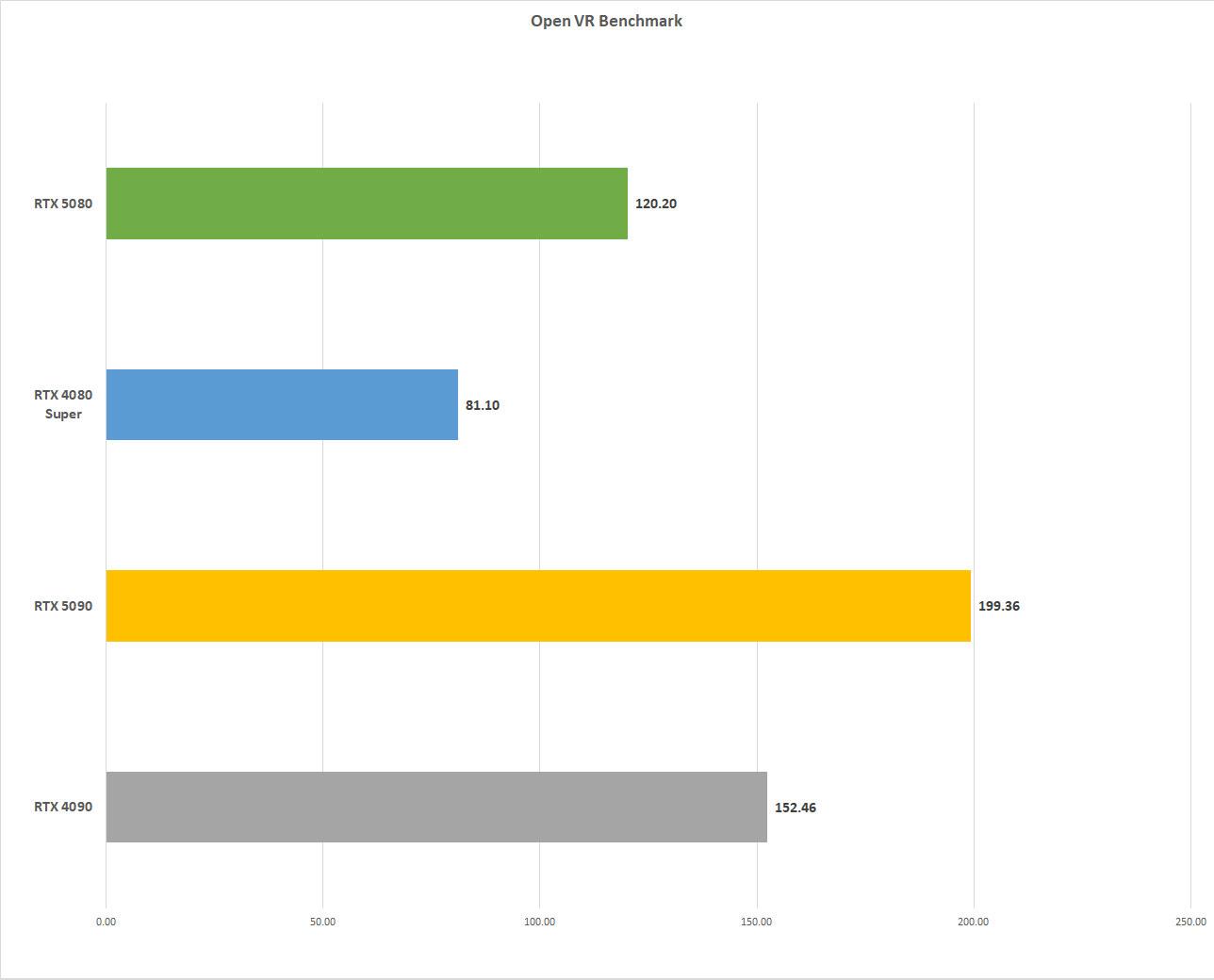
After reading about the disappointing uplift in raster performance for the 50xx series of cards, I was very pleasantly surprised to read Gaming Nexus' review that included some Open VR benchmark results, showing a 50% increase over the 4080 :eek: :

61.jpg


I don't know if this benchmark is seen as a good way to measure VR performance, but I do wonder what in the 50xx series architecture could be the reason for these surprisingly good results in something that should be based on rasterization performance, when that has only showed 10-20% improvements on regular 2D gaming?

These results, if valid, combined with the overclocking results on the 5080 makes this series much more enticing for me.
 
IDK outside of a few handful of demanding titles, I think DLSS4 is the bigger deal for VR. And with that coming to 40XX cards if you have one I would wait.
 
Looking at the gap between the 4080s and the 4090 it seem large, versus other similar benchmark results....

unconstrained-repl-jpg.jpg
 
Last edited:
Why were Amd 7000 series results not included in these results? Lame comparison!
An old at least, taht was I think around 4080-4090 launch, when 7000 series had yet to exist, november 2022:
https://babeltechreviews.com/the-1199-rtx-4080-vr-performance-review/

But for the point that the gap between the 4080s and the 4090 (i.e. the 4080s here could be a bit low maybe something was going on and could be the reason the 5080 has a 50% higher score, no need for the 7000 series)
 
5080 is a model, not the series.
and ive never hear of this test, you should include a link...
 
There are 4 cards in that, be happy one AMD card was included. It makes AMD overrepresented.

All I hear from people using AMD cards for VR is pain and regret.
That's likely because they don't know how to set up their gpu to get the boost algorithm to kick in. My 7900 performs almost as well as the 4080 models in VR when loaded properly. Amd's boost algorithm is quite different than Nvidias in VR sessions and requires some tweaking to get it really functioning to it's full capability. Yea it should just work buuuut it takes a little fiddling to get the best performance and most do not have the patience to take the time to figure it out. Instead they fall back to Amd sucks at VR. That's fine with me though as it's makes it easier for me to buy new cards when they release and I do not spend my time F5'ing to try for a new card. I'd rather spend my time tweaking parameters to maximize performance than wearing out my F5 key. Good talk though.
 
I hope so, I do a fair amount of VR and I have a 5080 on the way.

Part of the reason why I didn't go AMD, they've historically had issues with VR.
 
I hope so, I do a fair amount of VR and I have a 5080 on the way.

Part of the reason why I didn't go AMD, they've historically had issues with VR.

Well coming from a 3080, it should be a big upgrade. Depending on what you play that VRAM will be necessary. I don't play any VR only games, but I do use it for DCS, and when it hits a VRAM wall (it easily uses 12GB), performance will drop and eventually just freeze. And I'm only on a Quest 2, so the resolution is low for a VR headset.
 
Id like to hear alot more on this topic as i dont have alot of time to sort through threads or really test on my own. Im curious with how the 5000series gpu compares to amd in VR scenerios, as well as the x3d cpus VS non. Im currently on a 6900xt with an older non x3d cpu wanting to upgrade. but some say 9900x is better then 9800x3d for VR due to VR useing more threads etc. then it comes to 5000 series mops amd due to dlss even though amd raster an ram amounts dominaties nvidia. which seems out of the question for VR situations. If anyone has any hands on input please share!!!
 
OK in summary form if you want plug and play for VR Nvidia is the card for you as their GPUs usually just work(not always). My experience with the 7900XTX has been very good after some early adopter taxes but finding the optimal settings in VR has been an exercise in what sometimes seemed futile until I figured out how the boost algorithm works. Amd's boost algorithm is a bit complicated as algorithms generally are and gets lazy if not properly loaded. Bandwidth from memory is key here and Nvidia just has it in spades so this complicates what is required by the Amd end user to get the desired framerates/image quality. This also varies on a game by game basis as every game engine has different requirements for memory bandwidth. So if you're not into testing/optimizing every VR game you play then go with Nvidia if your budget allows if not I have a pretty good handle on what it takes to squeeze out everything Amd cards are capable of. As far as cpus go I highly recommend an X3D variant as no VR game I've played came near maxxing out my 7800 or 9800 cpu 16 threads and some do not use more than 1 or 2 threads but they like the extra cache to keep the loaded threads fed and keep the immersion breaking lag/stutters to a minimum.
 
Last edited:
could be bandwith becoming more important on that benchmark over time (as 4080s-5080 both has 16GB in quantity)
But the bandwith increase in the 5080 compared to the 4080 is 30% but the increase is 50%, is the bandwith really holding the GPU back that much?
 
But the bandwith increase in the 5080 compared to the 4080 is 30% but the increase is 50%, is the bandwith really holding the GPU back that much?
really doubt it, my first feeling is that the 4080s result on that graph are too low because there was an issue with the test.
 
really doubt it, my first feeling is that the 4080s result on that graph are too low because there was an issue with the test.
Could be, but I've seen other tests showing the same improvements in VR games.
And yes, there is a welcome 30% increase in bandwith on the 5080, but that doesn't translate into a +30% increase at 4K, just the usual 5-20% as seen in all the tests.

So why 50% in VR? 🤔
 
OK in summary form if you want plug and play for VR Nvidia is the card for you as their GPUs usually just work(not always). My experience with the 7900XTX has been very good after some early adopter taxes but finding the optimal settings in VR has been an exercise in what sometimes seemed futile until I figured out how the boost algorithm works. Amd's boost algorithm is a bit complicated as algorithms generally are and gets lazy if not properly loaded. Bandwidth from memory is key here and Nvidia just has it in spades so this complicates what is required by the Amd end user to get the desired framerates/image quality. This also varies on a game by game basis as every game engine has different requirements for memory bandwidth. So if you're not into testing/optimizing every VR game you play then go with Nvidia if your budget allows if not I have a pretty good handle on what it takes to squeeze out everything Amd cards are capable of. As far as cpus go I highly recommend an X3D variant as no VR game I've played came near maxxing out my 7800 or 9800 cpu 16 threads and some do not use more than 1 or 2 threads but they like the extra cache to keep the loaded threads fed and keep the immersion breaking lag/stutters to a minimum.
TY!! Do you talk over DM's? or are you will to chat it up else where so it doesnt fill the thread with randomness. Either way TY again for the info!
 
Well coming from a 3080, it should be a big upgrade. Depending on what you play that VRAM will be necessary. I don't play any VR only games, but I do use it for DCS, and when it hits a VRAM wall (it easily uses 12GB), performance will drop and eventually just freeze. And I'm only on a Quest 2, so the resolution is low for a VR headset.
DCS forced my 4080 upgrade. Brought 2080 ti to it's knees.
 
Why were Amd 7000 series results not included in these results? Lame comparison!
For many months 7000 series was not working properly in VR, performing worse than 6000. So yeah, including it in that old review would only have made AMD look terrible. Be grateful.

Nvidia also has a better video encoder which further cements their lead for wireless headsets (or wired with Quest headsets).
 
For many months 7000 series was not working properly in VR, performing worse than 6000. So yeah, including it in that old review would only have made AMD look terrible. Be grateful.

Nvidia also has a better video encoder which further cements their lead for wireless headsets (or wired with Quest headsets).
Indeed, even wired, the encoder makes a difference, since the Quest always uses streaming.
The AMD 7000 series wasn't restricted to lower performance, but also stuttering, which is a huge issue in VR and it indeed took them half a year to fix it.
 
Looks like memory overclocking on the 5080 may be a bit more limited than the wild stories surfacing online, with people just maxing out the slider at +2000 for 34 Gbps.
https://www.thefpsreview.com/2025/02/07/overclocking-nvidia-geforce-rtx-5080-founders-edition/
350-450 on the core and 500 on the ram seems to be the stable range, and most of the performance comes from the core clock lift not the memory bandwidth, since doesn't seem that either Ada or Blackwell are bandwidth limited in most cases.
 
For many months 7000 series was not working properly in VR, performing worse than 6000. So yeah, including it in that old review would only have made AMD look terrible. Be grateful.

Nvidia also has a better video encoder which further cements their lead for wireless headsets (or wired with Quest headsets).
OH ok thanks for your concern.
 
DCS forced my 4080 upgrade. Brought 2080 ti to it's knees.
If the RTX 2080 Ti was bad enough, try running it on a GTX 980, and you have my situation.

The big difference? I had originally bought the RX 7900 XTX first, and that performed so awfully at launch that when someone offered a trade for an RTX 4080, I jumped at the chance and didn't look back. Apparently, AMD fixed a VR performance regression in later drivers, but I wasn't willing to wait when my card also had the defective vapor chamber issue limiting performance further.

It's rather frustrating that Eagle Dynamics makes this flight sim that looks so good in VR, yet you need at least a $1,000 GPU to make it a playable experience (4080's kinda just under the GPU frame time threshold for a Valve Index at 90 Hz) - a price that hasn't really come down with this utter clown show of a new GPU generation launch.

IDK outside of a few handful of demanding titles, I think DLSS4 is the bigger deal for VR. And with that coming to 40XX cards if you have one I would wait.
I presume you just mean any enhancements to the upscaling part, because NVIDIA's frame-gen does not help VR in the slightest.

It's a cheat that still adds input latency, whereas the objective of VR performance is to have the lowest motion-to-photon latency possible, and frame gen in the form of spacewarp/reprojection/etc. is a last resort to keep performance dips from becoming nauseatingly uncomfortable. Fake frames simply do not work in a medium that heavily relies on head-tracking at all times.

DLSS upscaling does seem to help noticeably for performance in No Man's Sky, though. I don't know if DCS supports it.

Id like to hear alot more on this topic as i dont have alot of time to sort through threads or really test on my own. Im curious with how the 5000series gpu compares to amd in VR scenerios, as well as the x3d cpus VS non. Im currently on a 6900xt with an older non x3d cpu wanting to upgrade. but some say 9900x is better then 9800x3d for VR due to VR useing more threads etc. then it comes to 5000 series mops amd due to dlss even though amd raster an ram amounts dominaties nvidia. which seems out of the question for VR situations. If anyone has any hands on input please share!!!
Without getting another RX 7900 XTX to personally evaluate their current drivers, which is very unlikely at this point in time with every high-end GPU sold out and scalped to high hell, I can't confirm if it's a viable alternative to NVIDIA right now - but it sure as hell wasn't at launch, to the point that the RTX 4080 steamrolled it handily. I still don't regret that trade one bit.

As for the Ryzen X3D CPUs, they are the best choice in CPU-limited VR titles bar none - someone actually benched 'em in DCS, which now has a multi-threaded update that did a lot to alleviate the CPU bottleneck to start with.

Note the frame time chart at 16:20, where the 9800X3D and 7800X3D are leftmost and have a decisive lead, though Intel's i7-13700K is about on par with a 5800X3D.

View: https://www.youtube.com/watch?v=2s9tWzhIdRE
 
DLSS upscaling does seem to help noticeably for performance in No Man's Sky, though. I don't know if DCS supports it.
I assume he meant dlss4 transformer upscaling which is a huge deal, not frame gen.
 
  • Like
Reactions: DPI
like this
I assume he meant dlss4 transformer upscaling which is a huge deal, not frame gen.
Very plausible, though NVIDIA hasn't marketed that feature nearly as prominently as the frame gen.

It's frustrating and confusing with how NVIDIA markets DLSS 4.0 in particular, because now we're all having to guess if it meant the upscaling as originally intended, or the frame gen that they're blatantly fluffing their benchmark numbers with.
 
I hope so, I do a fair amount of VR and I have a 5080 on the way.

Part of the reason why I didn't go AMD, they've historically had issues with VR.
Did you get your 5080 and test it in VR? I'm coming from a 3080 10Gb, so really curious about your experiences.
 
Did you get your 5080 and test it in VR? I'm coming from a 3080 10Gb, so really curious about your experiences.
It does run better, but I don't have any concrete numbers. I don't play stuff like flight sim or any really heavy games, but most things seem to run just fine.
 
Well finally got a 5090 without F5ing my keyboard to death and I must say it is quite impressive in MSFS 2020 in VR. The memory bus width (512) and speed (1792GB/s) are the real deal for FS2020 streaming assets (textures ,scenery etc.) in real time. The power consumption is amazingly low when optimized for my headsets 16.6 Megapixel native resolution (Pimax Crystal Lite) and easily sustains a very smooth 72 FPS at just 320 watts using DLSS. I do not intend not to melt the power connector on this card so trimming the power down everywhere I can is a real concern. All things considered including the cards price I'm super happy I got lucky enough to get this GPU without any real effort and I'm extremely happy with the clarity and performance the card supplies for my VR flight sims.
 
Back
Top