
DukenukemX
[H]F Junkie
- Joined
- Jan 30, 2005
- Messages
- 11,511
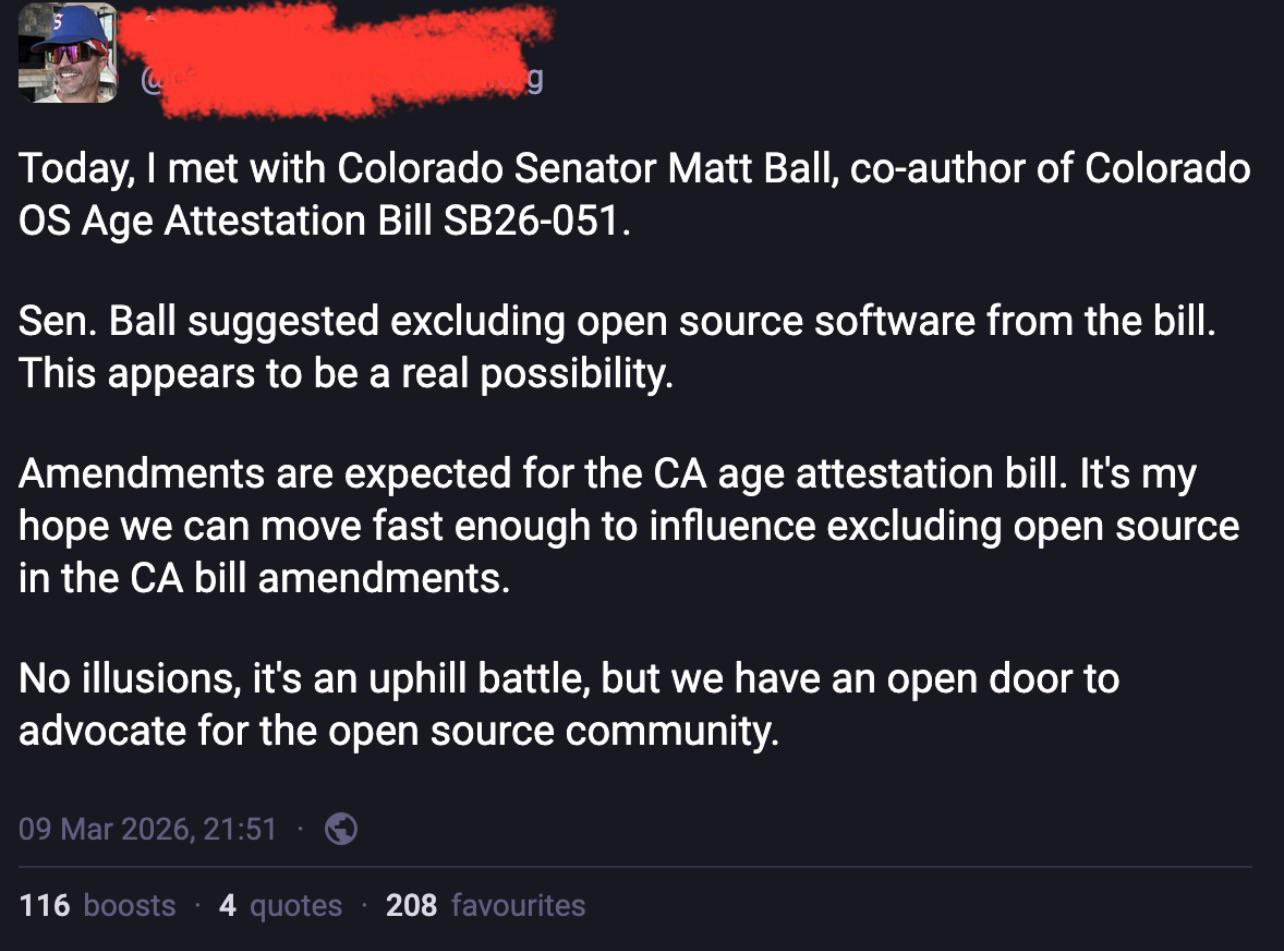
The good news is that age verification may exclude open source. Works for me since I rarely use closed source.
![[H]ard|Forum](/styles/hardforum/xenforo/logo_dark.png)
Follow along with the video below to see how to install our site as a web app on your home screen.
Note: This feature may not be available in some browsers.

“SystemD Adds Optional 'birthDate' Field for Age Verification to JSON User RecordsEditorDavid 37 minutes ago | 6 |
| "The systemd project merged a pull request adding a new birthDate field to the JSON user records managed by userdb in response to the age verification laws of California, Colorado, and Brazil," reports the blog It's FOSS. They note that the field "can only be set by administrators, not by users themselves" — it's the same record that already holds metadata like realName, emailAddress, and location:Lennart Poettering, the creator of systemd, has clarified that this change is "an optional field in the userdb JSON object. It's not a policy engine, not an API for apps. We just define the field, so that it's standardized iff people want to store the date there, but it's entirely optional. " In simple words, this is something that adds a new, optional field that can then be used by other open source projects like xdg-desktop-portal to build age verification compliance on top of, without systemd itself doing anything with the data or making it mandatory to provide. A merge request asking for this change to be repealed was struck down by Lennart, who gave the above-mentioned reasoning behind this, and further noted that people were misunderstanding what systemd is trying to do here. "It enforces zero policy," Poettering said. "It leaves that up for other parts of the system."” |

https://hardforum.com/threads/a-new...tion-at-account-setup.2046700/post-1046296768
“SystemD Adds Optional 'birthDate' Field for Age Verification to JSON User Records
EditorDavid 37 minutes ago6 "The systemd project merged a pull request adding a new birthDate field to the JSON user records managed by userdb in response to the age verification laws of California, Colorado, and Brazil," reports the blog It's FOSS.
They note that the field "can only be set by administrators, not by users themselves" — it's the same record that already holds metadata like realName, emailAddress, and location:Lennart Poettering, the creator of systemd, has clarified that this change is "an optional field in the userdb JSON object. It's not a policy engine, not an API for apps. We just define the field, so that it's standardized iff people want to store the date there, but it's entirely optional. "
In simple words, this is something that adds a new, optional field that can then be used by other open source projects like xdg-desktop-portal to build age verification compliance on top of, without systemd itself doing anything with the data or making it mandatory to provide. A merge request asking for this change to be repealed was struck down by Lennart, who gave the above-mentioned reasoning behind this, and further noted that people were misunderstanding what systemd is trying to do here.
"It enforces zero policy," Poettering said. "It leaves that up for other parts of the system."”
Something that people have been talking about for ages. A fork would be the best course of action.https://hardforum.com/threads/a-new...tion-at-account-setup.2046700/post-1046296768
Lots now talking about ditching any Linux distro that uses systemd...
The Engineer Who Tried to Put Age Verification Into Linux
Dylan, useful idiot with commit access, pushed age verification PRs to systemd, Ubuntu & Arch, got 2 Microslop employees to merge it, called it 'hilariously pointless' in the PR itself, then watched Lennart personally block the revert. Unpaid compliance simp.
Useful Idiot is a propaganda tool from the 1800's. Tends to be used a lot by the JIDF. Makes me rethink that source.
That didn't take long.
During his first-ever appearance before a jury in February, Meta's chairman and chief executive, Mark Zuckerberg, relied on his company's longstanding policy of not allowing users under the age of 13 on any of its platforms.
When presented with internal research and documents showing that Meta knew young children were in fact using its platforms, Zuckerberg said he "always wished" for faster progress to identify users under 13. He insisted the company had reached the "right place over time".
I'm reminded of the Samsung Magician software when you install it. "Are you a member of a European (GDPR country) or Brazil?"Seems like Debian is taking this much more seriously. At least they hired a lawyer and are considering separating age verification for places that require it.
Rather have that then be forced to install packages with age verification. If I can lie about my age then I can lie about my location. That way I'm not forced to install a systemD version that supports age verification.I'm reminded of the Samsung Magician software when you install it. "Are you a member of a European (GDPR country) or Brazil?"
"Are you a resident of Califoria, or..." click no
Once people are Ok with breaking the constitution, then what's to stop them from continuing? Wait 10 years and they'll require more to verify who you are before you can use your computer, and there's always that one guy who'll refer to this moment and claim we've lost our rights long time ago.What did you expec5? Once one state takes the first step the rest will follow.

"That one guy" baffles me. When our freedoms have been eroded we should be digging our heels in and refusing to give ground, not walking away.Once people are Ok with breaking the constitution, then what's to stop them from continuing? Wait 10 years and they'll require more to verify who you are before you can use your computer, and there's always that one guy who'll refer to this moment and claim we've lost our rights long time ago.
Now get a lawyer who can successfully argue that anonymity is a right in the Constitution. I'll wait...Once people are Ok with breaking the constitution, then what's to stop them from continuing? Wait 10 years and they'll require more to verify who you are before you can use your computer, and there's always that one guy who'll refer to this moment and claim we've lost our rights long time ago.
That's a loaded statement right there. First off, that's admitting that this is tracking you. Secondly, this isn't about anonymity but freedom of speech. It could lead to breaking anonymity, which is what I fear. Thirdly, not being anonymous is breaking the First Amendment of the constitution. Not only that, but it was already tested in court with McIntyre v. Ohio Elections Commission, 514 U.S. 334 (1995). Any good lawyer can just use that to argue their case.Now get a lawyer who can successfully argue that anonymity is a right in the Constitution. I'll wait...
Why? Cause you said so? Constitution is above all laws. The only reason this law passes is because they know there's nobody who's going to fight them in court. The biggest detering is knowing that going to court is going to take a massive amount of money. Especially with this administration where breaking the constitution is now an Olympic sport.I'm not saying I agree with it, I'm just saying arguing Constuitonality of it isnt going to work.
People don't have time for that, they are too busy feeding their lives into Social Media apps and getting virtual likes to boost their lack of self confidence..."That one guy" baffles me. When our freedoms have been eroded we should be digging our heels in and refusing to give ground, not walking away.
That's how they hope this goes. If Joe Six pack even hears about this, he'll never think about again because "think of the children". The moment Microsoft and Apple asks for Joe's age then Joe won't even think twice. If anything, it's to remind all the people he meets how old he is. Even his Email which is joesixpack99@gmail.com has his birth year at the end, like a lot of people do. It's only a problem if Windows and MacOS asks for a photo or his ID, because then it's annoying and delays him using the sexbox.People don't have time for that, they are too busy feeding their lives into Social Media apps and getting virtual likes to boost their lack of self confidence...
And then throw in the attention span of a rock...this stuff hits the news, people get raged, and by next week they are back to talking about the latest episode of House Wives of [H] and "OMG did you see what happened"
Your privacy's already gone, it has been for quite some time now,
adding an age to your OS is unlikely to have any meaningful effect on the problem of privacy at all.

An unfortunate combination but true enoughPeople don't have time for that, they are too busy feeding their lives into Social Media apps and getting virtual likes to boost their lack of self confidence...
And then throw in the attention span of a rock...this stuff hits the news, people get raged, and by next week they are back to talking about the latest episode of House Wives of [H] and "OMG did you see what happened"
 .
.
But Freedom of speech does not apply to private companies, so is this where they can push something like this against companies, but not individuals, and thus said companies do need to enforce it, as the constitution would not come into play?That's a loaded statement right there. First off, that's admitting that this is tracking you. Secondly, this isn't about anonymity but freedom of speech. It could lead to breaking anonymity, which is what I fear. Thirdly, not being anonymous is breaking the First Amendment of the constitution. Not only that, but it was already tested in court with McIntyre v. Ohio Elections Commission, 514 U.S. 334 (1995). Any good lawyer can just use that to argue their case.
Why? Cause you said so? Constitution is above all laws. The only reason this law passes is because they know there's nobody who's going to fight them in court. The biggest detering is knowing that going to court is going to take a massive amount of money. Especially with this administration where breaking the constitution is now an Olympic sport.
I'm not even sure what you're pointing out? Nobody is blaming companies for this since they have to comply with the law. I'm not going after Microsoft, Google, and Apple for going along with age verification because their OS's are already a privacy risk. They could lobby against this but you'd never see them do that. I'm talking specifically about open source operating systems where it's been proven that source code is freedom of speech, and therefore open source is really freedom of speech. No government should have the power to determine how an open source OS should work. Technically, they shouldn't have the same power over corporations and their OS's, but whatever.But Freedom of speech does not apply to private companies, so is this where they can push something like this against companies, but not individuals, and thus said companies do need to enforce it, as the constitution would not come into play?
If companies do things at the behest of the government they can be considered an arm of the government for certain purposes, like this one.But Freedom of speech does not apply to private companies, so is this where they can push something like this against companies, but not individuals, and thus said companies do need to enforce it, as the constitution would not come into play?
No, not because I've said so, because there hasn't been any push back against this in any way. This is a lost cause. You're out in public "you have no expectation of privacy" is the rank and file explanation for why things like Flock cameras and other types of surveillance are ok, sure you have privacy advocates that do push back against that sort of thing, but nothing ever goes so far as the US Supreme Court. That McIntire case, the only reason it went as far as it did was because the guys speech was stifled, and the government who stifled it did so claiming you couldn't be anonymous while handing out election material. Cart before the horse, and all of that.Why? Cause you said so?
That's where you're a bit mistaken, it's not that the Constitution is above all laws, it's the interpretation of the Constitution by 9 people set by various presidents as the US Supreme Court that is above all laws. Tell me there hasn't been a SCOTUS decision that left so many absolutely baffled beyond all belief? It doesn't happen often, thankfully, but it does happen, and hopefully someday a future court overrules those, e.g. Plessy v. Ferguson "Separate but equal" was perfectly fine, only until Brown v. Board of Education was that overturned as unconstitutional.Constitution is above all laws.
I wouldn't say that's the only reason, there are plenty of people who are happy to see this happen, and then there are others who are not happy to see it but don't see it as a violation of the Constitution. And yes, going to court is costly, but if places like the ACLU or EFF aren't going to fight it, it may say something about what they think they can do with it. Sure they don't like it, but they may not see anything inherently illegal about it.The only reason this law passes is because they know there's nobody who's going to fight them in court. The biggest detering is knowing that going to court is going to take a massive amount of money.
You mean besides the number of Linux distros that vowed to not implement this?No, not because I've said so, because there hasn't been any push back against this in any way. This is a lost cause.
You must have missed the thread where I'm totally against Flock.You're out in public "you have no expectation of privacy" is the rank and file explanation for why things like Flock cameras and other types of surveillance are ok,
Must have missed the part where the hatred for Flock has results in a number of towns removing them like Lynnwood, WA, Redmond, WA, Santa Cruz, CA, and Coralville, IA. It's only ignored because people don't know about them. It isn't a problem until Police come knocking at your door and accuse you of robbery. Also Brazilians are already trying to fight back with age verification.sure you have privacy advocates that do push back against that sort of thing, but nothing ever goes so far as the US Supreme Court.
It's still unconstitutional. It's also against the Brazilian constitution.That's where you're a bit mistaken, it's not that the Constitution is above all laws, it's the interpretation of the Constitution by 9 people set by various presidents as the US Supreme Court that is above all laws. Tell me there hasn't been a SCOTUS decision that left so many absolutely baffled beyond all belief? It doesn't happen often, thankfully, but it does happen, and hopefully someday a future court overrules those, e.g. Plessy v. Ferguson "Separate but equal" was perfectly fine, only until Brown v. Board of Education was that overturned as unconstitutional.
Laws like these don't appear because people got together and thought of the children. Someone is spending money on this, like millions of dollars. Did you know OpenAI funded Parents & Kids Safe AI Coalition? Did anyone know Meta funded age verification? There doesn't exist a thing where randos get together to try and make the world a better place. Nobody would give them money and they'd therefore stop existing. These exist because companies like Meta funded it.I wouldn't say that's the only reason, there are plenty of people who are happy to see this happen, and then there are others who are not happy to see it but don't see it as a violation of the Constitution. And yes, going to court is costly, but if places like the ACLU or EFF aren't going to fight it, it may say something about what they think they can do with it. Sure they don't like it, but they may not see anything inherently illegal about it.
Age Verification Lobbying: Dark Money, Model Legislation & Institutional Capture
How corporate lobbying, think tank infrastructure, competing model legislation, and obscured funding networks are shaping age verification policy across 45 states and Congress.
And so it begins.....This will just for now be like when Steam asks you to enter your DoB to view a game.. no actual check...just something to cover their butt, but you know next they will push for integration into actual verification, and Microsoft will probably go ahead, do it, force down Home Users first.....
I wonder how the government of California plans to enforce it?
Not to be cynical here, but how many legislators actually understand these issues well enough to write amendments to the original law. What I'm leading up to is that lobbyists probably wrote the draft bill and then passed that along to lawmakers."California lawmakers unanimously pass Linux exemption from age-verification law — software distributed under the GPL, MIT, BSD, and Apache licenses are exempt
AB 1856 excludes open-source operating systems from the upcoming Digital Age Assurance Act.
California’s legislature has passed Assembly Bill 1856, exempting open-source operating systems from the State’s Digital Age Assurance Act months before the law is due to take effect on January 1, 2027. The Senate amended the Bill on August 21 before passing it on the 26th in a 39-0 vote, with the Assembly then accepting these changes in a concurrence vote the following day. The amendment ends almost a year of uncertainty surrounding whether Linux distributions and SteamOS would be forced to collect user age data during account setup alongside Windows, macOS, iOS, and Android. AB 1856 has now been sent to Governor Gavin Newsom, who signed the original act into law last October.
These amendments redefine the term “operating system provider” to exclude any person or entity that distributes an OS or application “under license terms that permit a recipient to copy, redistribute, and modify the software.” Any software distributed under the GPL, MIT, BSD, and Apache licenses satisfies that test, which removes the likes of Debian, Fedora, Ubuntu, Arch, and the BSD family from AB 1856’s scope.
A second exclusion removes software components that aren’t “offered to consumers as a stand-alone executable application through a covered application store” from the law’s definition of an application, covering libraries and dependencies distributed through package managers like apt and pacman. AB 1856 doesn’t explicitly say that repos aren’t app stores, but a store’s main obligation under the law is to request an age signal from the user’s OS provider and pass it to developers; an exempt open-source OS produces no signal. A third carve-out excludes storefronts distributing extensions or add-ons that run exclusively inside a host application, which takes browser extension stores out of scope."
https://www.tomshardware.com/softwa...he-gpl-mit-bsd-and-apache-licenses-are-exempt
Replying to myself, does that mean that Apple and Microsoft will open source their OS's? Not bloody likely, but I had to ask.Not to be cynical here, but how many legislators actually understand these issues well enough to write amendments to the original law. What I'm leading up to is that lobbyists probably wrote the draft bill and then passed that along to lawmakers.
Cali-who?Fortunately, Linux doesn't need to comply. Instead, distros can geo-block entire California, and keep serving everyone else. It's not like it's going to lose a sale over it

Not to be cynical here, but how many legislators actually understand these issues well enough to write amendments to the original law. What I'm leading up to is that lobbyists probably wrote the draft bill and then passed that along to lawmakers.
“California's Age Verification Bill Passes with Linux Exemption IntactEditorDavid 2 hours ago | 12 |
| California's age-verification bill has passed in its legislature — but with its open-source carve-out intact, reports the blog Linuxiac: Back in May, we reported that California lawmakers amended Assembly Bill 1856 to carve open-source operating systems out of the state's upcoming age verification requirements. Three months later, that exemption survived the legislative process intact, and the bill has cleared both chambers of the California Legislature... sending the measure to Engrossing and Enrolling, the final legislative preparation stage before it can be presented to Governor Gavin Newsom... For operating systems that are covered, AB 1856 builds on California's Digital Age Assurance Act, which is scheduled to take effect on January 1, 2027. Under the current text, when an operating system runs on a device and includes an account setup feature, its provider must offer an interface that asks the account holder for the birth date, age, or both, of the device's primary user during account setup. The operating system must then be capable of providing a digital age signal to covered application stores and application developers through a reasonably consistent real-time API. Instead of exposing a precise birth date, the signal identifies one of four age ranges: under 13, 13 through 15, 16 through 17, or 18 and older... Covered application stores must request the signal from the operating system and make it available to developers.” |
