![[H]ard|Forum](/styles/hardforum/xenforo/logo_dark.png)
X8XFoundries
Limp Gawd
- Joined
- Mar 4, 2025
- Messages
- 208
The AMD BC-250 is a very interesting machine to me.
If you don’t know the history if this hybrid pile of vomit, trees some links.
https://www.tweaktown.com/news/9500...cards-that-are-now-on-ebay-for-500/index.html
https://theretroweb.com/chips/10290
https://www.techpowerup.com/cpu-specs/ryzen-4700s.c3326
https://browser.geekbench.com/v6/cpu/9461137 (specifically 8GB version, I am only interested in 16GB’s)
https://github.com/mothenjoyer69/bc250-documentation
The basic breakdown is this.
Remember when the PS5 was supposed to come out like 4 times and it didn’t and it was “due to chip issues”? It wasn’t due to chip issues, it was due to this beautiful abomination.
In some sort of sick combination of greed, recycling, and having no clue what the hell to do with perfectly fine APU’s (come on Sony, playstation mobile??????1?111?1??/?/?///?), Sony, Asrock, and AMD all came together to make a very silly “bitcoin mining” platform to try and bank on the market craze, however I think they completely missed something.
View: https://www.youtube.com/watch?v=UvdoILrlwww
View: https://www.youtube.com/watch?v=FCIeqRgRNSQ
View: https://www.youtube.com/watch?v=J1NxcgasTIU
View: https://www.youtube.com/watch?v=eTq793n2-sA
View: https://www.youtube.com/watch?v=JXIEt7MH4Qs
https://www.ibm.com/docs/en/zos-bas...n-mainframe-hardware-logical-partitions-lpars
So before anything about LPAR, they missed the perfect corporate marketing opportunity in working together.
When Apple went to PowerPC they had dumped loads of work into it, working with IBM and Motorola, creating the AIM alliance….. Well….. We coulda had AMD, AsRock, Sony…..
AAsS.
COUGH
Anyways, if you know anything about hardware passthrough, and VM’s, IBM LPAR’s are VM’s on meth. Essentially your Power 5 CPU, honestly the damn things are so bloody big I’m going to call it a Compute Plate Unit, can be logically divided on-die, and die logic can be grouped if you had, say, 8 CPU’s in a drawer. Instead of having everything be virtual, the only “Virtual” part of the whole thing is basically firmware level, saying C0 on P0 groups with C3 and C4 on P5 and C1 on P7 in order to route data to not collide on huge huge demand, etc, is almost required when running, say, a junction for a cross ocean trunk, or needing real hardware “VM’s” in a trading center like NYCSE, there’s just nothing that can match it.
Now, the BC-250, on the other hand, is, to me, LPAR in reverse. Rather than dividing the cores up, you have _12_ slabs to choose how to cluster or use for entire service stacks. This doesn’t sound amazing at first since no one really uses GDDR for desktop crap, but I have a theory I want to test…. Mostly just to see what happens.
We have 2 types of NVMe drives, and each BC-250 slice, similar to the Apple nMP, runs off of a singular NVMe SSD. This SSD hooks up to a bus that can run at the same speed as the fastest R/W speeds of memory dies available, anywhere from 6800MT/s up to 8400MT/s, if you overclock.
I want to know what happens if you get a 16GB BC-250, and a Host Bus Memory NVMe Drive, which uses the host bus RAM as its cache, and test it against a DRAM cache SSD, testing if the memory type would change anything. I theorize that the DRAM would be slower, the only advantage really is that it’s basically directly hooked up to the Die itself. But I wonder what happens if the trunk is so ungodly big that it’s like free-falling into a bottomless pit…. What happens?
As well, there may be other systems out there that use HBM. I don’t really know, but why is it a 250? Is there a 150? What’s a 200? WHATS A 100??? How do ya’ll have a format for this already? What gives? I’m fascinated
The one thing I have to remember though is that using GDDR IS LITERALLY like free falling into a bottomless pit. If things bump into each other on the way down, everything gets punked and nothing works. I liken this to the difference to TCP and UDP data streams in your basic IP stack. Or using Jumbo Frames on your router after you hack it to bump up your data speeds to Twitch from OBS.
I mostly have interest in a full 12X rack because I believe, if set up correctly, it would be uncontrollably fast. However, there seems to be a few builders outside of AsRock, so leading question…. What’s the backplane do? Can I plug in a 100GBPS NIC into the backplane and dump that trunk to the slices? Is the at least like a GBe trunk the slices can communicate thru? What the hell does the thing do?
If I were to investigate the slices by themselves, the leading thing I need to know is what all the signals actually are to the backplane. Do I need to tape it, or will it also communicate to a computer? I have some silly things I would do with one, like put it in a G5 Quad, or a Pentium 4 Extreme PC. Just….. Because. Something something VLIW GPU Netburst Itanium LULW etc.
For right now, since I have decided, god dammit, these are at most 1500 bucks, I’m BUYING ONE ASAP, I need to test some things in theory. To do that I am going to beat the absolute piss, snot, shit, and childhood, out of my 2013 Mac Pro.
Don’t worry it likes it.
Or at least Steve Jobs Does.
Kek.
Basically I have a content dingus I am starting that is ultimately going to lead to my own version of The Retro Web but for recycling, and ultimately building anything from scratch, as well as FOSS contributions. There’s this whole study going around about purposely engaging your creativity, funnily enough by people who look like they live the most drab flat colored lives ever, but the idea sticks sort of.
It’s the same thing that got Tyler The Creator where he is. But this isn’t the place to have an existential crisis.
The nMP, the tragic thing it is, surprisingly lines up at the Drag Strip pretty thoroughly with the BC-250.

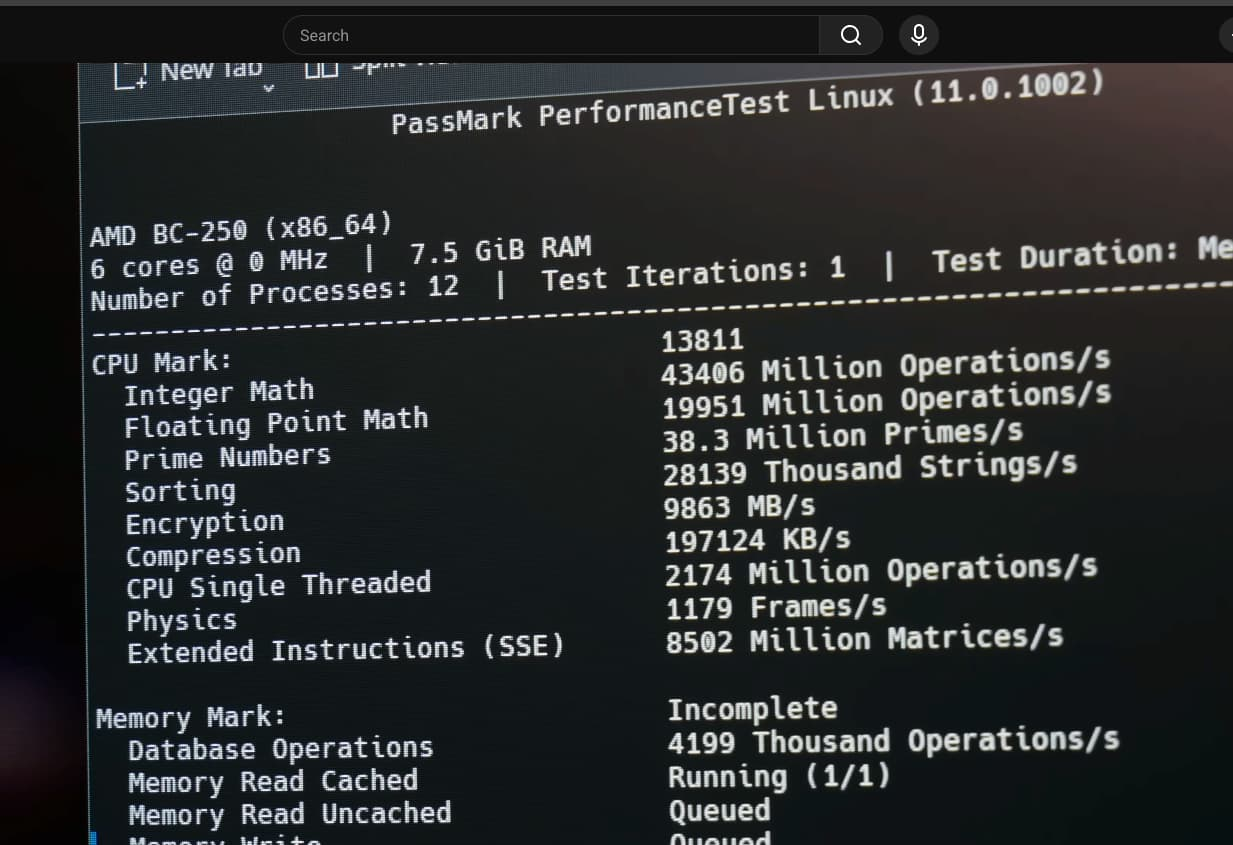
This is a benchmark from my personal Mac Pro, compared to the BC-250 presented in this video.
View: https://www.youtube.com/watch?v=_zbw_A9dIWM
These are…. Close. Annoyingly enough finding actual results that mean dick all is impossible so I guess I am buying every 2011 V0 V1 and V2 CPU and slamming them through benchmarks in my nMP, along side the video test.
Basically, because of my whole “Purposely Engaging Creativity” crap, I have a nonsensical amount of dependency on GPU power as much as CPU power. And with all my content output, I genuinely need the biggest video encoder box on the planet.
See where I am going here?
So before I get a BC-250, I need to somewhat test my idea. I need to make sure I couldn't put something better together with what I have, but really, because the benchmarks are SO close, I really want to get into the idea of how small the footprint really will be (3 BC-250's in the space of 1 nMP).
The nMP is going to use all 3 blades. The CPU, and each GPU. I’m going to leave the stock SSD from apple in there so the SMC can have absolutely 0 errors (I saw the log with the PCIe adapter SSD I had in there, holy shit the collisions). Either the machine will be running Windows 8.1, a heavily HEAVILY modded iso of the Windows 10 AME Alpha I still have (no I am not distributing it) that will tell me almost everything I need to know in its logging tools if any GPU driver problems occur, or I run linux and I pray to god that nothing explodes. No, OSX is not on the table.
The CPU will be pointed to an IceCast host somewhere and will be pushing a 5880X3440 canvas. You might think that this is ridiculous and kills the CPU, however even on the most intense encoder, it’s 2-6% at most in OBS. Each GPU will hold, or clone and downscale, the main canvas to a 1080P ish (1907p) image for YouTube, Twitch, TikTok, and…. Uh.... Idk… something, I can fit 4 streams on the nMP D300’s, and I wanna thermally smash it, but however that adds up blah blah whatever.
Basically the upgrade here is that you go from an nMP that’s kind of a turd because the D300 is a Sky500 or S7000 or some nonsense, and it bugs out because it expects a failure that isn’t there……VS RDNA2, Zen 2, a 7000MT/s friggin BUS.
AND 12 IN A BOX
Literally once I added all of this together I decided that I would keep my garbage Dell PS4000E SAN, stack it with a full 32TB of SSD’s, and when I get this BC-250 rack, hook the 2 together. Tada, throw my Dell R510 in the middle for a management box and you have a data center that’s about 3 feet tall.
Suck it Linus Tech Tips.
If this all lines up I’m gunna die.
If you don’t know the history if this hybrid pile of vomit, trees some links.
https://www.tweaktown.com/news/9500...cards-that-are-now-on-ebay-for-500/index.html
https://theretroweb.com/chips/10290
https://www.techpowerup.com/cpu-specs/ryzen-4700s.c3326
https://browser.geekbench.com/v6/cpu/9461137 (specifically 8GB version, I am only interested in 16GB’s)
https://github.com/mothenjoyer69/bc250-documentation
The basic breakdown is this.
Remember when the PS5 was supposed to come out like 4 times and it didn’t and it was “due to chip issues”? It wasn’t due to chip issues, it was due to this beautiful abomination.
In some sort of sick combination of greed, recycling, and having no clue what the hell to do with perfectly fine APU’s (come on Sony, playstation mobile??????1?111?1??/?/?///?), Sony, Asrock, and AMD all came together to make a very silly “bitcoin mining” platform to try and bank on the market craze, however I think they completely missed something.
View: https://www.youtube.com/watch?v=UvdoILrlwww
View: https://www.youtube.com/watch?v=FCIeqRgRNSQ
View: https://www.youtube.com/watch?v=J1NxcgasTIU
View: https://www.youtube.com/watch?v=eTq793n2-sA
View: https://www.youtube.com/watch?v=JXIEt7MH4Qs
https://www.ibm.com/docs/en/zos-bas...n-mainframe-hardware-logical-partitions-lpars
So before anything about LPAR, they missed the perfect corporate marketing opportunity in working together.
When Apple went to PowerPC they had dumped loads of work into it, working with IBM and Motorola, creating the AIM alliance….. Well….. We coulda had AMD, AsRock, Sony…..
AAsS.
COUGH
Anyways, if you know anything about hardware passthrough, and VM’s, IBM LPAR’s are VM’s on meth. Essentially your Power 5 CPU, honestly the damn things are so bloody big I’m going to call it a Compute Plate Unit, can be logically divided on-die, and die logic can be grouped if you had, say, 8 CPU’s in a drawer. Instead of having everything be virtual, the only “Virtual” part of the whole thing is basically firmware level, saying C0 on P0 groups with C3 and C4 on P5 and C1 on P7 in order to route data to not collide on huge huge demand, etc, is almost required when running, say, a junction for a cross ocean trunk, or needing real hardware “VM’s” in a trading center like NYCSE, there’s just nothing that can match it.
Now, the BC-250, on the other hand, is, to me, LPAR in reverse. Rather than dividing the cores up, you have _12_ slabs to choose how to cluster or use for entire service stacks. This doesn’t sound amazing at first since no one really uses GDDR for desktop crap, but I have a theory I want to test…. Mostly just to see what happens.
We have 2 types of NVMe drives, and each BC-250 slice, similar to the Apple nMP, runs off of a singular NVMe SSD. This SSD hooks up to a bus that can run at the same speed as the fastest R/W speeds of memory dies available, anywhere from 6800MT/s up to 8400MT/s, if you overclock.
I want to know what happens if you get a 16GB BC-250, and a Host Bus Memory NVMe Drive, which uses the host bus RAM as its cache, and test it against a DRAM cache SSD, testing if the memory type would change anything. I theorize that the DRAM would be slower, the only advantage really is that it’s basically directly hooked up to the Die itself. But I wonder what happens if the trunk is so ungodly big that it’s like free-falling into a bottomless pit…. What happens?
As well, there may be other systems out there that use HBM. I don’t really know, but why is it a 250? Is there a 150? What’s a 200? WHATS A 100??? How do ya’ll have a format for this already? What gives? I’m fascinated
The one thing I have to remember though is that using GDDR IS LITERALLY like free falling into a bottomless pit. If things bump into each other on the way down, everything gets punked and nothing works. I liken this to the difference to TCP and UDP data streams in your basic IP stack. Or using Jumbo Frames on your router after you hack it to bump up your data speeds to Twitch from OBS.
I mostly have interest in a full 12X rack because I believe, if set up correctly, it would be uncontrollably fast. However, there seems to be a few builders outside of AsRock, so leading question…. What’s the backplane do? Can I plug in a 100GBPS NIC into the backplane and dump that trunk to the slices? Is the at least like a GBe trunk the slices can communicate thru? What the hell does the thing do?
If I were to investigate the slices by themselves, the leading thing I need to know is what all the signals actually are to the backplane. Do I need to tape it, or will it also communicate to a computer? I have some silly things I would do with one, like put it in a G5 Quad, or a Pentium 4 Extreme PC. Just….. Because. Something something VLIW GPU Netburst Itanium LULW etc.
For right now, since I have decided, god dammit, these are at most 1500 bucks, I’m BUYING ONE ASAP, I need to test some things in theory. To do that I am going to beat the absolute piss, snot, shit, and childhood, out of my 2013 Mac Pro.
Don’t worry it likes it.
Or at least Steve Jobs Does.
Kek.
Basically I have a content dingus I am starting that is ultimately going to lead to my own version of The Retro Web but for recycling, and ultimately building anything from scratch, as well as FOSS contributions. There’s this whole study going around about purposely engaging your creativity, funnily enough by people who look like they live the most drab flat colored lives ever, but the idea sticks sort of.
It’s the same thing that got Tyler The Creator where he is. But this isn’t the place to have an existential crisis.
The nMP, the tragic thing it is, surprisingly lines up at the Drag Strip pretty thoroughly with the BC-250.
This is a benchmark from my personal Mac Pro, compared to the BC-250 presented in this video.
View: https://www.youtube.com/watch?v=_zbw_A9dIWM
These are…. Close. Annoyingly enough finding actual results that mean dick all is impossible so I guess I am buying every 2011 V0 V1 and V2 CPU and slamming them through benchmarks in my nMP, along side the video test.
Basically, because of my whole “Purposely Engaging Creativity” crap, I have a nonsensical amount of dependency on GPU power as much as CPU power. And with all my content output, I genuinely need the biggest video encoder box on the planet.
See where I am going here?
So before I get a BC-250, I need to somewhat test my idea. I need to make sure I couldn't put something better together with what I have, but really, because the benchmarks are SO close, I really want to get into the idea of how small the footprint really will be (3 BC-250's in the space of 1 nMP).
The nMP is going to use all 3 blades. The CPU, and each GPU. I’m going to leave the stock SSD from apple in there so the SMC can have absolutely 0 errors (I saw the log with the PCIe adapter SSD I had in there, holy shit the collisions). Either the machine will be running Windows 8.1, a heavily HEAVILY modded iso of the Windows 10 AME Alpha I still have (no I am not distributing it) that will tell me almost everything I need to know in its logging tools if any GPU driver problems occur, or I run linux and I pray to god that nothing explodes. No, OSX is not on the table.
The CPU will be pointed to an IceCast host somewhere and will be pushing a 5880X3440 canvas. You might think that this is ridiculous and kills the CPU, however even on the most intense encoder, it’s 2-6% at most in OBS. Each GPU will hold, or clone and downscale, the main canvas to a 1080P ish (1907p) image for YouTube, Twitch, TikTok, and…. Uh.... Idk… something, I can fit 4 streams on the nMP D300’s, and I wanna thermally smash it, but however that adds up blah blah whatever.
Basically the upgrade here is that you go from an nMP that’s kind of a turd because the D300 is a Sky500 or S7000 or some nonsense, and it bugs out because it expects a failure that isn’t there……VS RDNA2, Zen 2, a 7000MT/s friggin BUS.
AND 12 IN A BOX
Literally once I added all of this together I decided that I would keep my garbage Dell PS4000E SAN, stack it with a full 32TB of SSD’s, and when I get this BC-250 rack, hook the 2 together. Tada, throw my Dell R510 in the middle for a management box and you have a data center that’s about 3 feet tall.
Suck it Linus Tech Tips.
If this all lines up I’m gunna die.
Last edited:


