• Some users have recently had their accounts hijacked. It seems that the now defunct EVGA forums might have compromised your password there and seems many are using the same PW here. We would suggest you UPDATE YOUR PASSWORD and TURN ON 2FA for your account here to further secure it. None of the compromised accounts had 2FA turned on.
    Once you have enabled 2FA, your account will be updated soon to show a badge, letting other members know that you use 2FA to protect your account. This should be beneficial for everyone that uses FSFT.

Asus Equalizer GPU cable shipping with new Power Supplies

Comixbooks

Fully [H]
Joined
Jun 7, 2008
Messages
25,897
https://videocardz.com/newz/asus-ro...st-user-test-user-reports-9c-temperature-drop

ASUS-ROG-EQUALIZER-TEST-HERO-1200x624.jpg

This looks promissing lower temps with the GPU cable called The Equalizer by Asus. Might alleviate fears of melting cables.
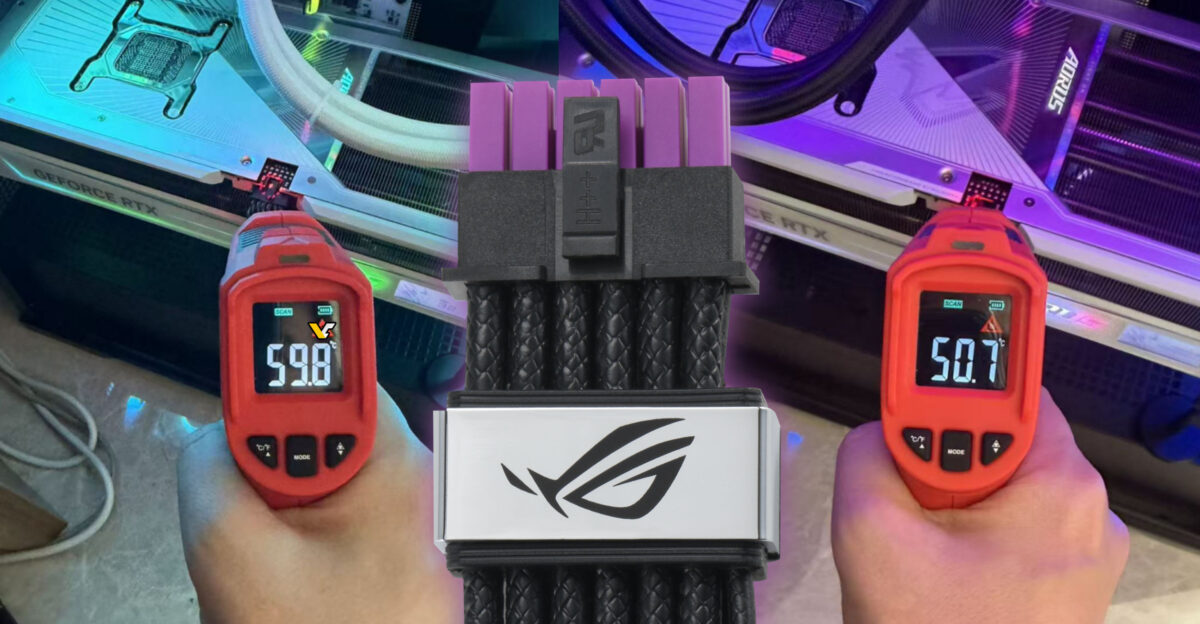
 
Cable wire diameters look good and hopefully soldered as well as crimped at the wire/connected pin junction. The plastic insertion component looks to be high solids density material although no mention of material yet. Pricing will be a factor but not really all things considered risk/rewards wise especially since the reports of failure haven't ceased at large. Even without the load balancing of the power supply it's included with it could be a wise addition if compatible with other brands of power supplies. Will be following this one closely for more information on construction ,compatibility and materials list used if published.
 
12v-2x6 connectors are the same on both ends so compatibility with other brands is basically guaranteed. The only exceptions are older PSUs that use 3 or 4 EPS slots on the PSU side to 12v-2x6- I have primarily seen these on older Corsair PSUs. That said, I wonder what Asus is actually doing with these cables- a teardown would be great. The pins are the primary weak link, not the wiring, so it'll be interesting to see what they have done to address that.
 
Cable wire diameters look good and hopefully soldered as well as crimped at the wire/connected pin junction. The plastic insertion component looks to be high solids density material although no mention of material yet. Pricing will be a factor but not really all things considered risk/rewards wise especially since the reports of failure haven't ceased at large. Even without the load balancing of the power supply it's included with it could be a wise addition if compatible with other brands of power supplies. Will be following this one closely for more information on construction ,compatibility and materials list used if published.
They specifically say it is compatible with other brands on their page. They do have an extra 2-pin plug on the PSU side that is supposedly used for voltage monitoring, but it is optional, even when using their PSUs (something the PSUs and cables had before this as well.

I like the idea fundamentally because it looks like it pushes up the safety factor, which is a concern with 12v-2x6.
 
They specifically say it is compatible with other brands on their page. They do have an extra 2-pin plug on the PSU side that is supposedly used for voltage monitoring, but it is optional, even when using their PSUs (something the PSUs and cables had before this as well.

I like the idea fundamentally because it looks like it pushes up the safety factor, which is a concern with 12v-2x6.
Thanks for the link to this. Had not taken the time to look yet and it is indeed looking like a must have for 90 series GPU.
 
Thanks for the link to this. Had not taken the time to look yet and it is indeed looking like a must have for 90 series GPU.
I mean I dunno about must-have, I really think the problems with the connector are overblown. According to the Aussies at Hardware Unboxed, vendors have shared RMA data with them and there is not a massive increase, so probably you are fine without it. I just upgraded a 4090 after 3 years of use and my connector was fine (I posted pictures here). However I do think it is a nice to have and puts the safety margin more in line with what I'd like to see.
 
hopefully soldered as well as crimped at the wire/connected pin junction

Solder + crimp is not generally considered to be a good practice, and is unlikely in a factory manufactured part. It's usually done in diy repairs when there's low confidence in crimping ability or it's a wonky crimp anyway, like you're putting two wires into one pin (sometimes needed to replace a factory IDC connector where the wire continues through and you don't want to do a separate two to one splice nearby), but that's not a configuration that should happen in a factory part. Factory crimping with quality pins, quality tools, quality process, and everything engineered for the currents and tempertures experienced in circuit result in long lasting connections.

Adding a soldering step means you're heating the pin way beyond the rating, which will loosen the crimp at the start of its life. You're going to damage wire insulation. You'll have solder wick into the wire and make it more brittle and less flexible. If that's how you want to build your cables, fine, but nobody will do it in a factory setting.
 
At the price these GPUs command, they should have a type-c thermal imaging camera so one can keep an eye on temps and know right away if they have trouble down the road. ;-)
 
Corsairs new power cable offering at half the price seems like a better deal. Ordered one just for the heck of it.
 
Sheesh, what's next? These "molex style" connectors were never meant to carry these kind of currents.

In future designs needing even more power perhaps a dedicated PSU will be necessary to prevent failure.

120A.png
 
Solder + crimp is not generally considered to be a good practice, and is unlikely in a factory manufactured part. It's usually done in diy repairs when there's low confidence in crimping ability or it's a wonky crimp anyway, like you're putting two wires into one pin (sometimes needed to replace a factory IDC connector where the wire continues through and you don't want to do a separate two to one splice nearby), but that's not a configuration that should happen in a factory part. Factory crimping with quality pins, quality tools, quality process, and everything engineered for the currents and tempertures experienced in circuit result in long lasting connections.

Adding a soldering step means you're heating the pin way beyond the rating, which will loosen the crimp at the start of its life. You're going to damage wire insulation. You'll have solder wick into the wire and make it more brittle and less flexible. If that's how you want to build your cables, fine, but nobody will do it in a factory setting.
Perhaps your should explain how this is bad practice to Robert Bosch automotive technology group since they do it regularly in all European makes and models for power and ground distribution. These "weld points" are employed where current flows can be very high and environmental effect is usually detrimental to longevity. Weld points can be found throughout the vehicles interior and exterior wiring harnesses where numerous crimps would be less than cost effective. The weld points appear to me to crimped and soldered in succession by a fully automated process.
 
Hello. I'm looking for recommendations for a power supply for a system built around an Intel i7-12700K and a Z790/B760 motherboard, currently paired with an RTX 3060 Ti but likely to be upgraded to an RTX 5060 Ti in the future. My priorities are quiet operation, strong build quality, long-term reliability, high efficiency, and fully modular cabling. I'm considering an 850W unit because I prefer having some extra headroom rather than running the power supply close to its limits. My thinking is that a higher-capacity PSU may operate more quietly under normal loads and potentially experience less wear over time. Given these requirements, which models would you recommend and why?
 
Hello. I'm looking for recommendations for a power supply for a system built around an Intel i7-12700K and a Z790/B760 motherboard, currently paired with an RTX 3060 Ti but likely to be upgraded to an RTX 5060 Ti in the future. My priorities are quiet operation, strong build quality, long-term reliability, high efficiency, and fully modular cabling. I'm considering an 850W unit because I prefer having some extra headroom rather than running the power supply close to its limits. My thinking is that a higher-capacity PSU may operate more quietly under normal loads and potentially experience less wear over time. Given these requirements, which models would you recommend and why?
Since you're new here, I'll give you a piece of advice while answering some of your questions at the same time. Start your own thread instead of hijacking an existing one, especially if your question has nothing to do with the original post.

You can't go wrong with any model from Seasonic or Super Flower. Other companies, like Corsair, MSI, Asus, etc. specify designs to OEMs like Seasonic to build their PSUs, so you have to research each model to see if it is good or not. That said, with Cybenetics testing, it's easier to find the good ones these days. A budget would be a good place to start for narrowing down your options.

A larger PSU isn't necessarily more efficient or quieter than a smaller one. In fact, with a small enough PSU, you can get completely passive fanless models. As for the 50% load peak efficiency, yes, PSUs are generally most efficient at 50% load. However, keep in mind that greatly oversizing your PSU will cause your idle efficiency to suffer and most games do not max out your system 100% anyways- 50-80% of max power draw is more common depending on the game. Targeting your PSU size based on max theoretical draw will generally land you in the ideal range unless you have serious plans about going to a family of more power hungry GPUs (i.e. xx80 or xx90 GPUs) or you plan on using your computer for something where your hardware will be running at 100% all the time.
 
Back
Top